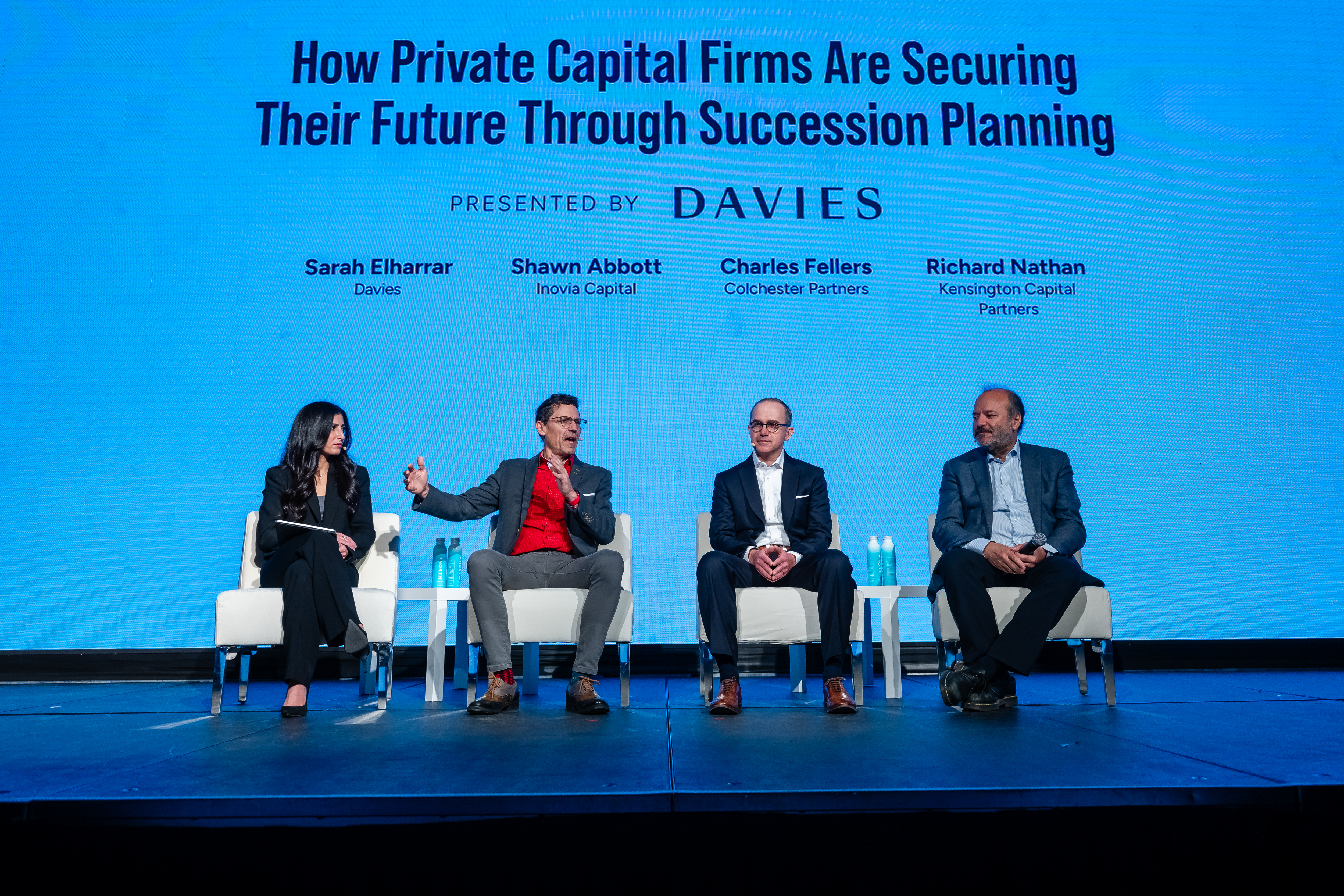
At Invest Canada ’25, a session led by Davies brought together three practitioners with direct experience managing firm transitions to examine what succession planning actually requires, and why the firms that treat it as a future problem are already behind.
What emerged was not a tidy formula but a nuanced map of decisions firms will need to make, and the tradeoffs they’ll face.
The panel featured Charles Fellers of Colchester Partners, Richard Nathan of Kensington Capital, and Shawn Abbott of Inovia Capital, moderated by Sarah Elharrar of Davies. Their conversation drew from decades of lived experience and advisory work. The session was designed for general partners who are actively thinking about how to manage ownership, preserve culture, and align long-term incentives as founding partners exit and new leadership emerges.
What emerged was not a tidy formula but a nuanced map of decisions firms will need to make, and the tradeoffs they’ll face.
The clearest point of alignment across panelists was the growing visibility of GP stake sales and external capital partnerships as tools to manage transitions. Fellers noted that firms are more willing to consider third-party investors than in the past. But he was also clear that these partnerships require discipline. Firms need to be honest with themselves about why they are raising capital. If it’s simply to bridge a gap in internal succession or to pull forward liquidity for senior partners, that can work, but it must be managed transparently.
Abbott reflected on Inovia’s own evolution and shared that the firm has gone through several cycles of internal discussion about ownership and continuity. He emphasized that generational transitions cannot be papered over with branding. Credibility comes from what partners actually do: how they make decisions, how they share economics, and how they prepare rising leaders to carry the firm forward. Inovia has worked to institutionalize founder thinking without letting the firm’s identity become hostage to any one person.
The challenge Abbott described, preparing rising leaders without losing institutional identity, points to a broader gap the sector has been slow to close. Informal mentorship and on-the-job learning have historically been the default, but firms navigating active transitions increasingly need more structured pathways. CVCA’s Canadian Private Capital Investment School, developed with the Ivey Academy, as well as CVCA’s Private Capital Governance Program, delivered in partnership with the Institute of Corporate Directors (ICD), were both built to address that gap, giving emerging professionals and board-level participants frameworks grounded in how Canadian VC and PE actually operates.
Nathan added that LPs now expect succession planning to be part of the conversation, particularly in re-ups and diligence. The days when firms could defer the topic or frame succession as a long-range concern are over. Nathan observed that GPs often underestimate how deeply LPs care about cultural stability. Transitions do not have to be immediate to raise questions, but they do need to be accounted for in narrative and strategy.
The panel also underscored that succession planning is not just about equity transfer or leadership appointments. It is also about values and the continuity of decision-making norms. Elharrar raised the issue of compensation structures that inadvertently concentrate influence in the hands of a few, making transitions brittle or opaque. This led to a discussion about the mechanics of incentive alignment.
Fellers pointed to compensation and governance as the two most common friction points in firm transitions. Without regular rebalancing, compensation schemes can freeze junior partners out or push emerging leaders to consider other firms. He also warned that waiting too long to address ownership changes makes transactions more expensive and destabilizing.
One recurring theme was the need for internal transparency. Abbott described how miscommunication or ambiguity about equity paths and governance roles can do long-term damage. He encouraged GPs to start communicating earlier than they think they need to. Not every conversation needs to result in an agreement, but delaying the conversation can fracture a firm when the founding generation starts to slow down.
Nathan raised an underexplored challenge: how to navigate a successful transition when a firm’s founders are still active and engaged. He noted that some founders are not ready to walk away entirely. The question then becomes how to reframe their role without undermining new leadership. One strategy is to shift focus to strategic initiatives or LP engagement rather than investment decision-making. This allows institutional memory to remain valuable without blocking renewal.
The discussion also touched on external optics. For firms raising new funds, signaling that a succession plan is in place, even if it’s still in motion, can increase confidence. Nathan added that formalizing governance and decision-making processes often helps mitigate concerns among LPs, even when transitions are still underway.
Elharrar closed the panel by noting that succession planning is ultimately an expression of how firms see themselves over time. Do they exist to serve a moment or to endure through cycles and people? The firms that answer that question clearly will not just survive ownership changes, they will be strengthened by them.
This session made clear that succession planning is no longer a back-office topic or a one-time conversation. For private capital firms operating in a market where LP scrutiny is high and new entrants are constant, building clarity around ownership, leadership, and identity is now a strategic imperative. The firms that invest in that clarity early will be positioned to lead with consistency, even as their people change.
Since 1979, Invest Canada has been where Canada’s private capital community comes together to build relationships, close deals, and share real-world experience. It’s the definitive forum for GPs and LPs to connect, collaborate, and uncover new opportunities. In 2026, the Invest Canada conference will be taking place in Halifax, May 26-28. Learn more here.