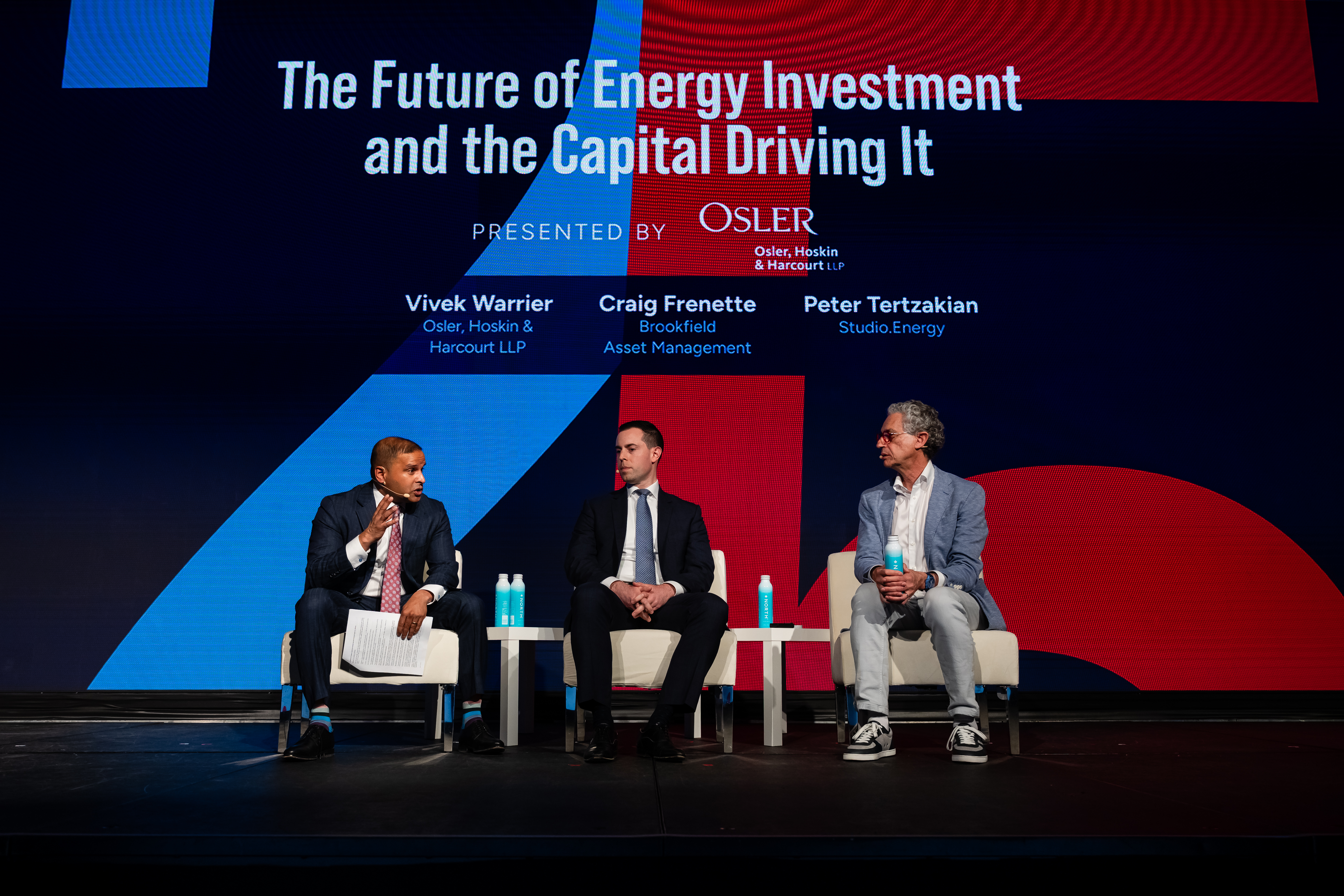
At Invest Canada ’25, a featured keynote presented by Osler, Hoskin & Harcourt LLP made the case that Canada’s energy transition would be decided by buildability. The year since has tested that thesis.
At Invest Canada ’25 in Calgary, a featured keynote and fireside presented by Osler, Hoskin & Harcourt LLP took up a question the federal government has spent the year since acting on: how capital should respond to mounting energy demand and the conditions needed to meet it. Economist and Studio.Energy founder Peter Tertzakian, Brookfield’s Craig Frenette, and Osler partner Vivek Warrier laid out the case from the stage. The Building Canada Act and the Major Projects Office have stood up since, alongside the Sovereign AI Compute Strategy now moving into execution. The session’s underlying analysis still holds.
Tertzakian opened the keynote by defining the challenge ahead: Canada is not merely undergoing an energy transition but entering a period of full-system transformation. Industrial energy demand is poised to change at a pace not seen in generations, driven by accelerating electrification, global climate policies, and the compounding load expectations of artificial intelligence. According to Tertzakian, the era of “clean tech pilot projects” is over. What lies ahead will require massive capital allocation, long-term planning, and an overhaul of regulatory pathways that have stalled project buildout across energy types.
Tertzakian highlighted what he calls a rising “crisis of buildability.” Canada has the physical resources and financial interest to lead in the global transition. Whether it can move quickly enough depends on how the new federal review architecture handles project volume. In his view, the private sector is willing to invest. The question is whether federal and provincial coordination can keep pace with that appetite. Without that foundation, energy projects, including those led by large, long-horizon investors, will continue to stall or divert elsewhere.
The stakes are shifting. Energy demand is no longer primarily shaped by homes, vehicles, and industry. AI infrastructure, particularly data centres, has entered the picture in a serious way. Frenette explained that Brookfield is already seeing this demand in real capital flows. Hyperscalers are signing power-purchase agreements and driving conversations about grid design and supply chain resilience. According to Tertzakian, the sector is underestimating how quickly that demand will overtake projections. Canadian activity has since accelerated, with a federal call for proposals on sovereign data centres above 100MW closing in February 2026 and AI infrastructure now central to the Major Projects Office mandate.
Private capital is watching these developments closely. While investors have long acknowledged that renewables, storage, and transmission are essential parts of the mix, the conversation is moving toward the technologies that can firm up base load in low-emission systems. That includes everything from modular nuclear to geothermal. Tertzakian emphasized that geothermal, while often overlooked, deserves a new examination. In particular, oil and gas regions with deep drilling expertise may have a competitive advantage in developing scalable geothermal capacity, offering a path for legacy energy firms to participate in a clean, dispatchable future. That argument has since gained physical proof points. DEEP Earth Energy advanced toward commissioning the first 25MW phase of its 200MW Saskatchewan geothermal project in 2026, and Alberta’s Drilling Accelerator moved forward with Eavor and Halliburton among its anchor participants. Frenette agreed that it is no longer about picking a single technology. It is about aligning capital with buildable projects and proven outputs across a wider set of energy sources. That handoff between venture capital and infrastructure capital is where the energy transition is being financed. Many of the technologies in this space move through venture rounds before pension funds and infrastructure investors enter at later stages.
One of the dominant takeaways was that capital, despite the risks, is not the limiting factor. Frenette was clear that capital appetite exists across pension funds, infrastructure investors, and private equity. The challenge is in the timelines. These are not quarterly-return environments. Alberta’s electricity system operator has since capped large-load grid connections at 1,200 megawatts until 2028, an example of how physical capacity, more than capital, is setting the pace in some Canadian markets. The February 2026 MOU between TransAlta, CPP Investments, and Brookfield is one example. It set the framework for a 230MW data centre at TransAlta’s Keephills site in Alberta, with potential to scale to one gigawatt. Transition capital is designed for longer holds, but that structure needs alignment. Frenette emphasized that long-term investors need certainty on permitting timelines and off-take arrangements. Without that, capital will continue to favour jurisdictions that offer predictable returns, even if the underlying energy mix is less green.
Tertzakian warned at the time of a gap between political rhetoric and physical investment, citing large hydro and wind projects that had stalled despite early optimism. For private capital, the signal was that project execution required deeper alignment between federal and provincial authorities, with Indigenous partnership built in from the start. The federal architecture introduced since the session has been designed in part to address exactly this. Concrete precedents have emerged. Cedar LNG advanced as the world’s first Indigenous-majority-owned LNG facility, with the Haisla Nation holding 50.1 percent. The Indigenous Loan Guarantee Program, doubled to $10B in March 2025, has since closed equity-stake transactions in pipeline and transmission infrastructure.
The conversation returned repeatedly to pragmatism. Frenette noted that the infrastructure opportunity is substantial, but private capital is not looking for vanity plays. Projects need strong economics, proven operators, and real output. Whether it is nuclear, storage, carbon capture, or transmission, investors are assessing execution feasibility just as much as climate impact. The appetite for innovative financing structures has increased, but only where they support shovel-ready, policy-backed projects with clear revenue profiles.
Audience interest in the room reflected that reality. Multiple investors attending the session noted the need for stronger interconnectivity across Canadian jurisdictions. The fragmentation of energy policy across provinces was identified as a critical risk. Tertzakian argued that Canada needs national-scale projects with regional coordination. This will be especially relevant for transmission corridors tied to data centre clusters, which often straddle borders or require bilateral grid planning.
What is changing is that climate, infrastructure, and digitization are no longer separate investment themes. The capital stack for energy transition is being shaped as much by AI as it is by ESG. Frenette pointed out that the demand curve for clean, reliable electricity is no longer theoretical. The world’s largest corporates are demanding firm supply and are willing to sign long-term agreements to get it. That shifts the power dynamics between offtakers and producers, and it introduces a role for private capital to finance the middle layer that connects supply to demand.
This middle layer is where some of the most investable opportunities may emerge, whether in transmission infrastructure or grid stabilization technologies. Tertzakian closed the session by underscoring the need for national dialogue about this challenge. Canada has a long history of major energy project execution, but it must now build for a different market reality. If it fails to act, the capital will not wait.
The conversation at Invest Canada ’25 made clear that Canada’s energy leadership is not a given. The country’s natural resource endowment offers a strong platform. Competitiveness will come down to project execution and how quickly the new federal review process can absorb the pipeline of proposals now sitting in front of it.
Since 1979, Invest Canada has been where Canada’s private capital community comes together to build relationships, close deals, and share real-world experience. It’s the definitive forum for GPs and LPs to connect, collaborate, and uncover new opportunities. In 2026, the Invest Canada conference will be taking place in Halifax, May 26-28. Learn more here.