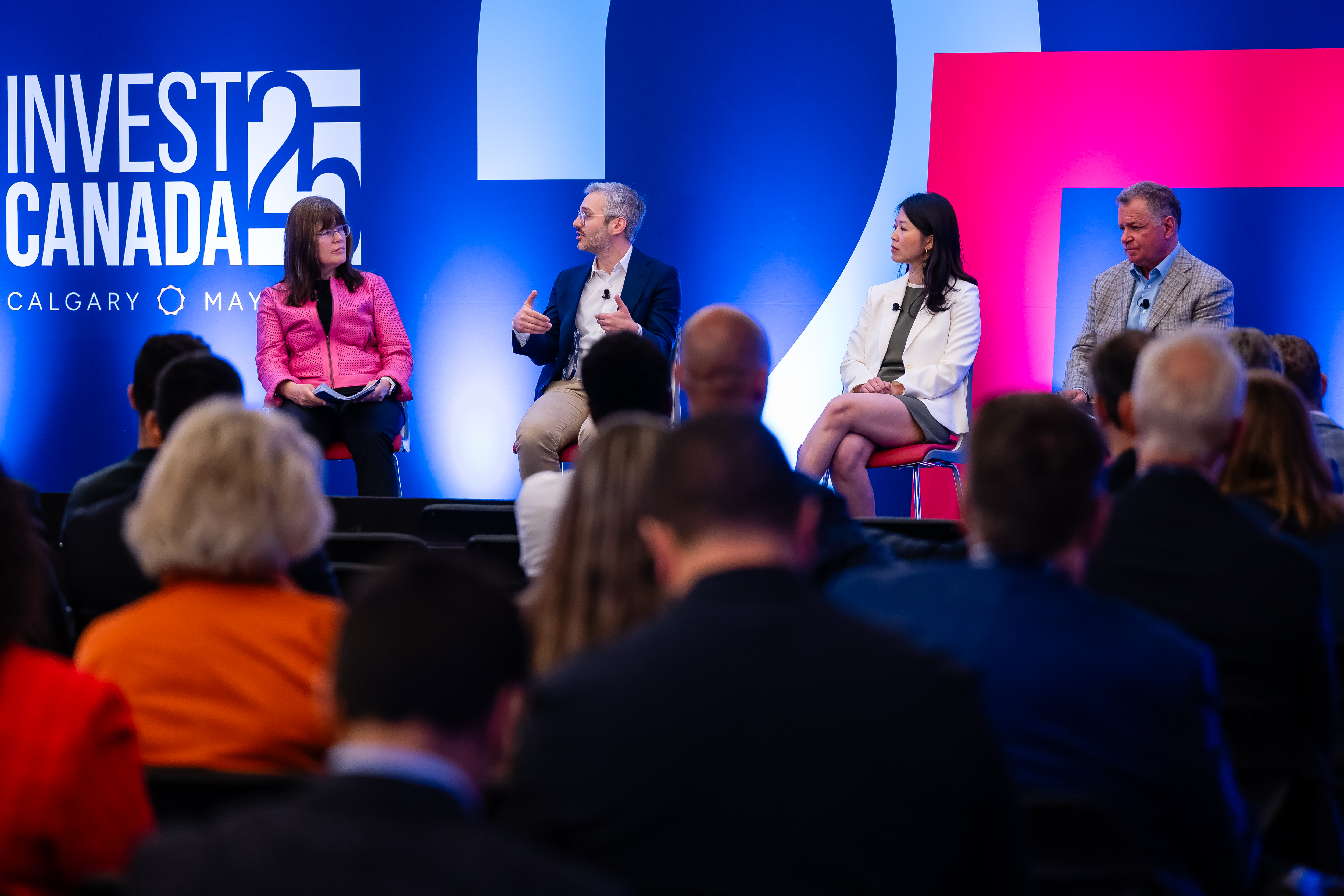
Three executives with firsthand experience scaling Canadian venture-backed companies gathered at Invest Canada ’25 to share what scaling a company looks like from the people who lived it.
Scaling a Canadian venture-backed company to a multi-billion-dollar outcome is not a straightforward journey. Success in this environment is not just a product of grit or timing. It hinges on clear capital pathways, strong founder-investor alignment, disciplined growth pacing, and strategic adaptability in the face of market shifts.
At Invest Canada ’25, Export Development Canada hosted a VC-focused breakout featuring executives from Clutch Technologies, Solium Capital, and Bellus Health who have each played a central role in building or leading Canadian growth stories. The session avoided simplifications. Instead, the speakers offered an honest look at what it takes to move a company from early momentum to long-term relevance.
Participants in the session were reminded that investor alignment does not mean full agreement on every decision. It means working with investors who understand when to step in and when to let operators lead. Several speakers emphasized the importance of investor behaviour during downturns, especially when companies fall short of initial forecasts. Founders and senior leaders often find themselves reforecasting with tighter timelines and new assumptions. When that happens, the role of the board becomes magnified.
Panelists noted that seasoned board members know how to navigate tension without creating further disruption. One example from the discussion involved recognizing when a team member had moved into the wrong role for the company’s current stage. Rather than pushing for an exit, the board worked with management to reposition the person into a function where they could still contribute. The point was not to protect anyone’s feelings but to preserve institutional knowledge and keep the team stable while the company was reforecasting against new assumptions.
The conversation also highlighted how leadership transitions are often the most consequential periods in a company’s life cycle. Sometimes founders step aside. Other times new executives are brought in to scale the business. In both cases, the success of the transition depends on whether the culture can stretch without snapping. The speakers agreed that continuity of purpose matters more than continuity of personnel.
When discussing the path to unicorn status, several speakers pushed back against the fixation on valuation as a performance proxy. They argued that internal execution and operational discipline are more reliable signals of a company’s potential than any headline number. One speaker emphasized that growth-stage companies should resist the urge to chase follow-on capital without a tight grasp on capital efficiency and return on invested resources. Another noted thatF investor expectations can become unrealistic when valuation milestones are reached before product maturity.
Access to capital remains a critical issue, but the quality of capital matters just as much. Panelists noted that alignment between founders and investors should begin well before a term sheet is signed. One speaker described spending roughly a third of their time engaging with investors outside of active fundraising rounds, treating those interactions as a two-way vetting process. The goal was to test whether a potential partner understood the sector, shared the vision for where the company was going, and could handle the honest conversations that come with a difficult quarter. Some founders accept term sheets that look good on paper but come with burdensome governance or a mismatch in risk appetite, often because that groundwork was never laid. The session emphasized that long-term scaling often requires working with capital that is ready to support cross-border expansion, new product development, or strategic talent acquisition without constant friction over short-term numbers.
Hiring was another focus. Canada’s tight labor market presents ongoing challenges for scaling firms, particularly those that need specialized talent to move into new markets or sustain product innovation. The panelists spoke about the trade-offs between local hiring and recruiting globally. One insight that stood out was the need for teams to operate with clarity around mission, especially when remote or distributed. Talent density was seen as less of a location problem and more of an alignment problem. When everyone is pulling toward the same outcome, geographic spread becomes less of a drag.
Another recurring theme was timing around going public. One speaker shared that they regretted not going public earlier when conditions were more favorable. Others acknowledged the risk of entering public markets before a business has predictable performance metrics. The audience heard that the IPO is not the finish line. It changes the rhythm of accountability and requires a company to reset its internal communications, investor strategy, and growth benchmarks.
The session closed with a discussion about the role of Canadian policy and its ability to either support or stall growth. A few speakers underscored the importance of export-oriented mindsets and programs that help Canadian companies establish a global presence. They acknowledged the reality that many scaling companies outgrow the domestic market faster than policymakers are prepared to accommodate. When that happens, firms often look south for capital, customers, or partnerships. The challenge is not simply about keeping companies in Canada, but ensuring they can grow here without being structurally disadvantaged.
The insights shared in this session did not present a single playbook. Instead, they reinforced the need for investors to be more than capital providers. The most effective investors act as partners who understand that success comes from matching the right capital to the right company at the right time, then knowing when to stand back and let the team execute.
Since 1979, Invest Canada has been where Canada’s private capital community comes together to build relationships, close deals, and share real-world experience. It’s the definitive forum for GPs and LPs to connect, collaborate, and uncover new opportunities. In 2026, the Invest Canada conference will be taking place in Halifax, May 26-28. Learn more here.