Suppose an investment memo says a software company’s largest customer has renewed for three years. The deal partner opens the document cited by the artificial intelligence (AI) tool that summarized the contracts. It is a proposal awaiting the customer’s approval. The signed agreement expires next quarter.
The partner catches the mistake before the investment committee meets. During the next fundraise, a limited partner (LP) asks how the firm checks AI-assisted work. Could someone who was not on the deal show the LP what the partner found and how it changed the forecast?
In October, the Ontario Securities Commission (OSC) reported on its review of how selected registered firms use AI. Its preliminary findings included firms without written AI policies, little or no oversight of AI tools supplied by vendors, and marketing claims about AI that some firms could not substantiate. A full report is due this fall. The OSC’s examiners and that LP are asking the same question: can the firm show, from its own files, what a person checked and what changed? For private equity and venture capital general partners (GPs), the answer is in the deal file.
Where the CSA guidance applies
In December 2024, the Canadian Securities Administrators (CSA) published Staff Notice and Consultation 11-348. It explains how existing securities law applies to AI and creates no new requirements. For registered firms, staff expects controls suited to the way the firm uses AI. Firms must keep records that demonstrate compliance and remain responsible for functions they outsource. A specific example is client reporting. When AI helps prepare those reports, the firm should check a sample for accuracy. For advisers and dealers, staff expect clear disclosure when AI may directly affect the services they are registered to provide. Guidance of this kind still shapes examinations. The OSC made firms’ response to the notice an examination priority in 2025, and by January 2026 its staff were reviewing how selected firms use AI.
Whether a private capital manager is subject to those obligations depends on its activities. The companion policy to National Instrument 31-103 gives a venture capital and private equity example. A manager that is actively involved in managing its portfolio companies generally does not need to register as an investment fund manager. Nor does it need to register as an adviser or dealer, provided its advice is incidental to that role and its fundraising is occasional and uncompensated. The analysis can change if the manager does more. Even where registration is not required, an LP can ask how the manager supervises AI or seek specific commitments about its data.
What examiners may ask for is now public, and an LP can use the same list. In May 2026, the International Organization of Securities Commissions published a supervisory toolkit for AI, developed by a working group that includes the OSC and Quebec’s Autorité des marchés financiers. The records it lists include an inventory of AI uses, support for any AI claims, and evidence that a person reviewed the output.
Before confidential information goes into a tool
An approved tool can still be the wrong place for a particular document. Before uploading a contract, check the seller’s confidentiality agreement and the data room rules. For LP information, check the limited partnership agreement and any relevant side letter. Permission to share material with an AI provider depends on the wording. The same wording governs whether an LP may put the fund’s reports into its own AI tools. A vendor’s promise not to train on uploads does not give the GP permission to make the upload. If the agreement is unclear, obtain permission or review the material without the tool.
Then check what happens under the firm’s actual subscription and settings. Can the provider use files to train a model? Who can access prompts and outputs, and when are they deleted? Record the answers beside the approved use and the person who authorized it. Revisit the approval if a provider switches on a new feature, such as a meeting assistant that can also search the firm’s shared folders.
Personal information raises a separate question. Canada’s privacy commissioners advise organizations to establish their authority to use it and limit what they share. To assess customer concentration, a coded revenue schedule may be enough. Leave out contact and banking details that add nothing to the analysis.
If someone uploads a confidential document by mistake, stop further sharing and tell the person responsible for privacy or compliance. That person can work with the vendor to contain the disclosure and assess any notice obligations.
Testing an investment screen
Match the check to the investment decision. Reading a letter edited by AI is straightforward. Checking a venture fund’s model for ranking pitches is harder: partners may never see the companies it puts at the bottom. Have a partner read a sample of those pitches and note which ones deserved a meeting. If a promising company was screened out, the investment lead can reconsider the criteria or pause the screen. Reviewing only the shortlist tells the fund little about what it missed.
What an LP can verify
The Institutional Limited Partners Association last updated its due diligence questionnaire in November 2021, and it contains no question on AI. It does ask managers about their investment process, data security, and outside providers. AI now fits into each area. Goodwin partner Kaitlin Betancourt has described investors asking to be notified of incidents and seeking assurance that managers will keep LP information out of public AI tools unless the LP agrees.
Before the next fundraise, prepare a one-page account of where the team uses AI, where it is off limits, who approves exceptions, and who checks the work. Keep a redacted example available. Compare the account with the fundraising deck: if a tool summarizes diligence documents but plays no part in selecting investments, the deck should say what the team actually does.
In the software deal, the useful evidence is the change to the base case. The deal partner verified the expiry date against the signed contract and moved the proposed renewal to the upside case. Keep the signed contract in the data room. In the deal file, reference the clause alongside the partner’s dated correction and the forecast the committee saw. A redacted extract can show an LP what changed without disclosing the customer’s identity or circulating a copy of the contract.
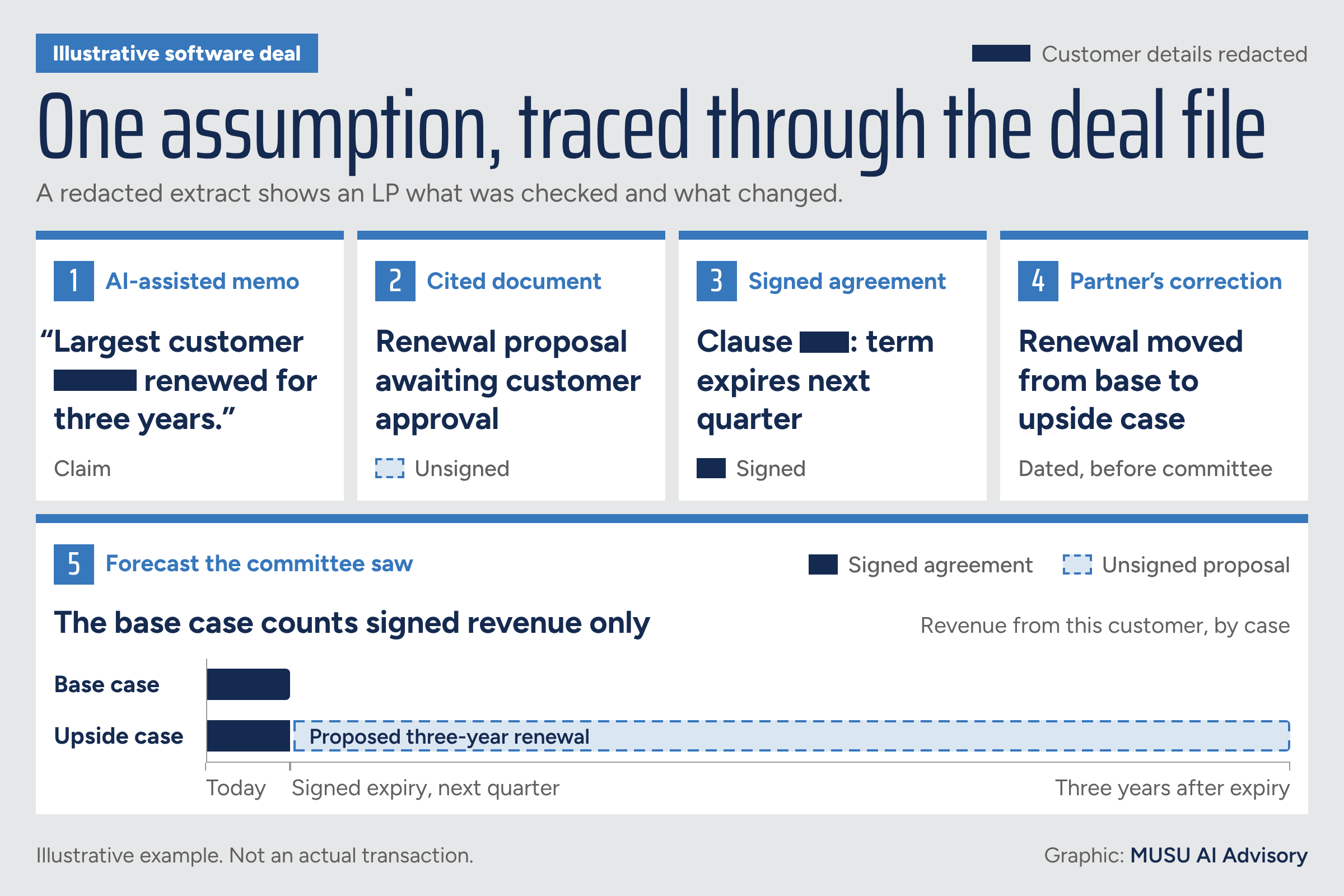
In this illustrative software deal, checking a proposed customer renewal against the signed contract changed the revenue forecast. Graphic: MUSU AI Advisory.
A test for the next 90 days
Start by asking investment, finance, and investor relations staff which AI tools they actually use, including features built into software the firm already buys. In the second month, assign an owner to each use and record what information the tool may handle. By day 90, give a partner who was not involved in the deal a recent memo and ask them to trace one material assumption.
In the software example, that means finding the signed expiry date and the forecast that uses it. If only the original analyst can explain the change, the firm knows which step to fix before the next investment meeting.
Sam Uddin is co-founder and chief advisory officer of MUSU AI Advisory, an independent firm that advises private equity and venture capital managers on adopting and governing AI. He previously served as a senior economist at the Ontario Securities Commission and the International Organization of Securities Commissions, and as a senior adviser at Saudi Arabia’s Capital Market Authority.
For related reading, see MUSU AI Advisory on how private capital firms can oversee AI in their daily work.