As climate change became an increasingly urgent concern in the early 2000s, a group of principals at RDH, a Canadian consulting and engineering firm, began focusing on practical ways to improve building energy efficiency. They identified a major gap in the market: commercial-grade windows that could meet the performance demands of low-carbon buildings. In 2008, that insight led them to launch Cascadia Windows & Doors, a Langley, B.C.–based manufacturer of high-performance fiberglass products.
“For buildings to become truly energy efficient, fiberglass was the clear answer,” says Mike Battistel, Cascadia’s co-founder and president. “It’s durable, strong, resistant to UV degradation and far less conductive than materials like aluminum, which makes it ideal for keeping buildings well insulated. We patented a design that could make that kind of high-performance window a reality.”
Despite launching during the 2007–09 financial crisis, Cascadia quickly found traction. Over its first five years, revenue increased at a compound annual rate of 25 per cent as the company gained ground in net-zero projects across the Pacific Northwest. To support its next stage, Cascadia began seeking investors to help finance a larger manufacturing facility and launch new products, including a world-first fiberglass window wall system designed for high-rise façades.
Those ambitions caught the attention of Renewal Funds, a Vancouver-based impact venture capital firm investing in companies with environmental or social benefits. “If you want to make a difference on climate change, the building envelope is one of the most important places to look,” says Paul Richardson, Managing Partner of Renewal Funds. “Cascadia was a local company with patented products that offered a practical, scalable way to improve building efficiency, so it fit our portfolio perfectly.”
Transforming Innovation into Impact
In 2014, Renewal Funds formally invested in Cascadia, providing growth capital as well as strategic guidance. The firm added two members to Cascadia’s board and introduced the company to its network across the construction industry, helping expand its customer base. Just as importantly, Renewal Funds shared Cascadia’s long-term outlook. “They weren’t focused on short-term gains,” says Battistel. “They wanted to see the company scale over five to 10 years, and that aligned with how we were thinking about the business.”
With Renewal Funds’s support, Cascadia immediately implemented its growth plans. In 2015, the company opened a new 90,000-square-foot manufacturing facility, more than triple the size of its previous facility. Cascadia also expanded its product portfolio, launching its Universal Series windows in 2015 and its fiberglass window wall system in 2019. The company’s Universal Series windows would soon feature prominently in landmark B.C. projects, including the University of Victoria’s Čeqʷəŋín ʔéʔləŋ (Cheko’nien House) student residence and dining complex, as well as the seven-storey 825 Pacific, the province’s tallest Passive House-certified building, both completed in 2022.
Like many manufacturers, Cascadia also faced significant external challenges, from the disruptions of the COVID-19 pandemic to the introduction of U.S. tariffs in early 2025. Richardson says Renewal Funds’ role during those periods was not to react impulsively, but to provide stability. “Construction is a cyclical industry with inevitable highs and lows, so we helped Cascadia stay calm, remain patient and keep executing its strategy, while also providing additional capital when needed,” he says.
Expanding Across North America
With its phase of growth complete, Cascadia turned its attention to an even larger opportunity: expanding across North America. To support that next chapter, the company’s original owners and Renewal Funds sold their stakes in September 2025 to a consortium of investors led by Montreal-based MKB Equity Partners, with participation from the Canada Growth Fund and Blue Earth Capital.
Richardson says identifying the right successor was as crucial as the investment itself. “When we exit a company, we want to ensure the next owners share our long-term perspective and commitment to creating a positive impact,” he explains. “With this consortium, we found investors who believe in the management team and the company’s potential. We’ve been blessed to work alongside Mike and his team, whose expertise, customer focus and humble leadership have positioned Cascadia for continued success.”
Alongside its geographic expansion into markets such as Eastern Canada, the northeastern United States and California, the company plans to increase its manufacturing capacity to better serve new customers. Projects such as Yale Divinity School’s Living Village, a zero-waste student residence completed in 2025 using Cascadia’s products, demonstrate the broader market potential for high-performance building envelopes. Cascadia also recently introduced a fiberglass window that meets the California State Fire Marshal’s wildfire-resistance standard, positioning the company to meet growing demand for climate-resilient construction materials as wildfires become more frequent across the continent.
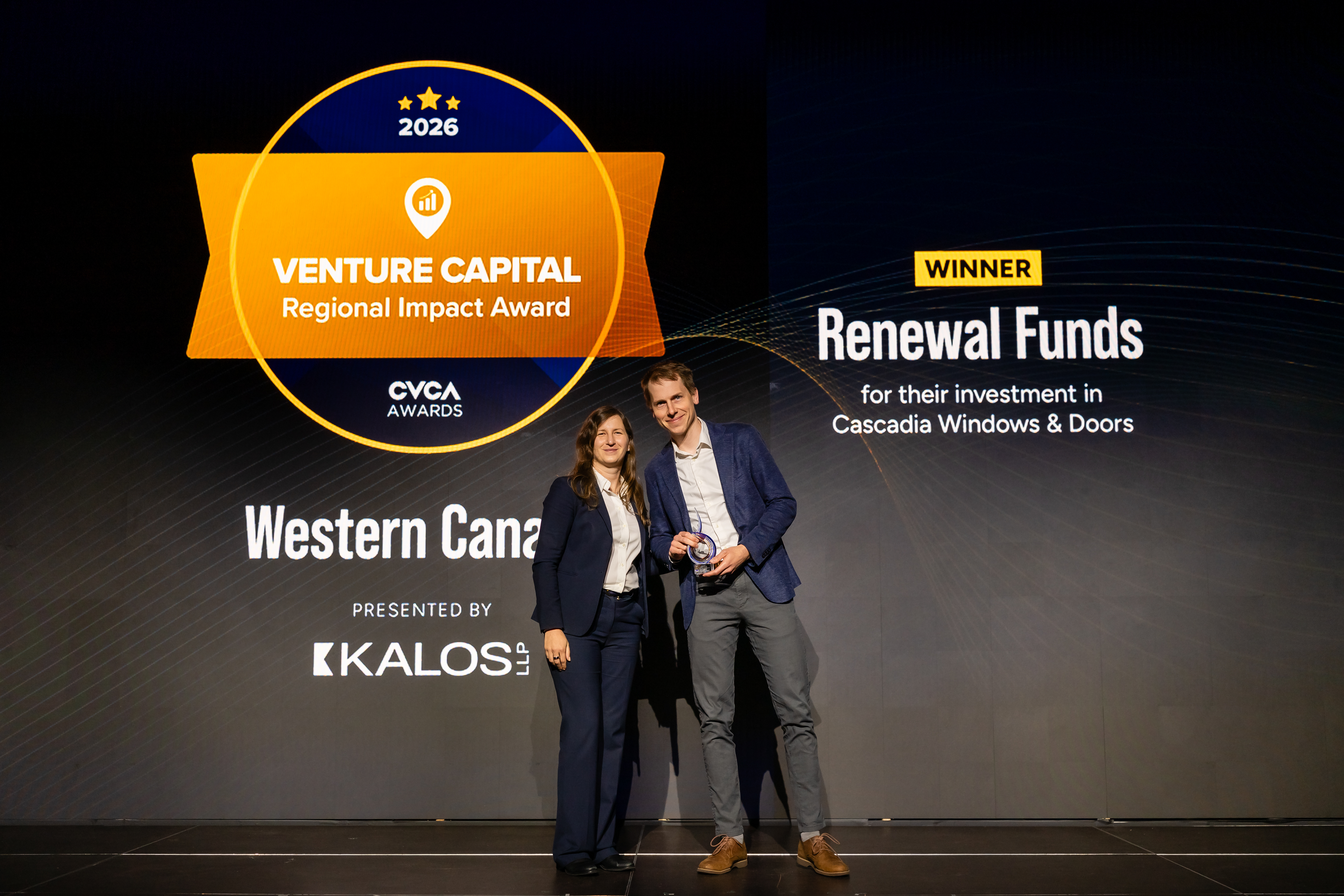
Battistel and Richardson both view their partnership as a major success. During Renewal Funds’ investment, Cascadia grew from 70 employees to more than 160 while sustaining approximately 20 per cent compound annual revenue growth. Those results helped earn Renewal Funds the VC Regional Impact Award, Western Canada, sponsored by KALOS. “It was invaluable to have Renewal Funds alongside us for a decade,” says Battistel. “They challenged us, held us accountable and were a true part of the team. It was an outstanding partnership, and a big reason we’ve been able to achieve what we have.”