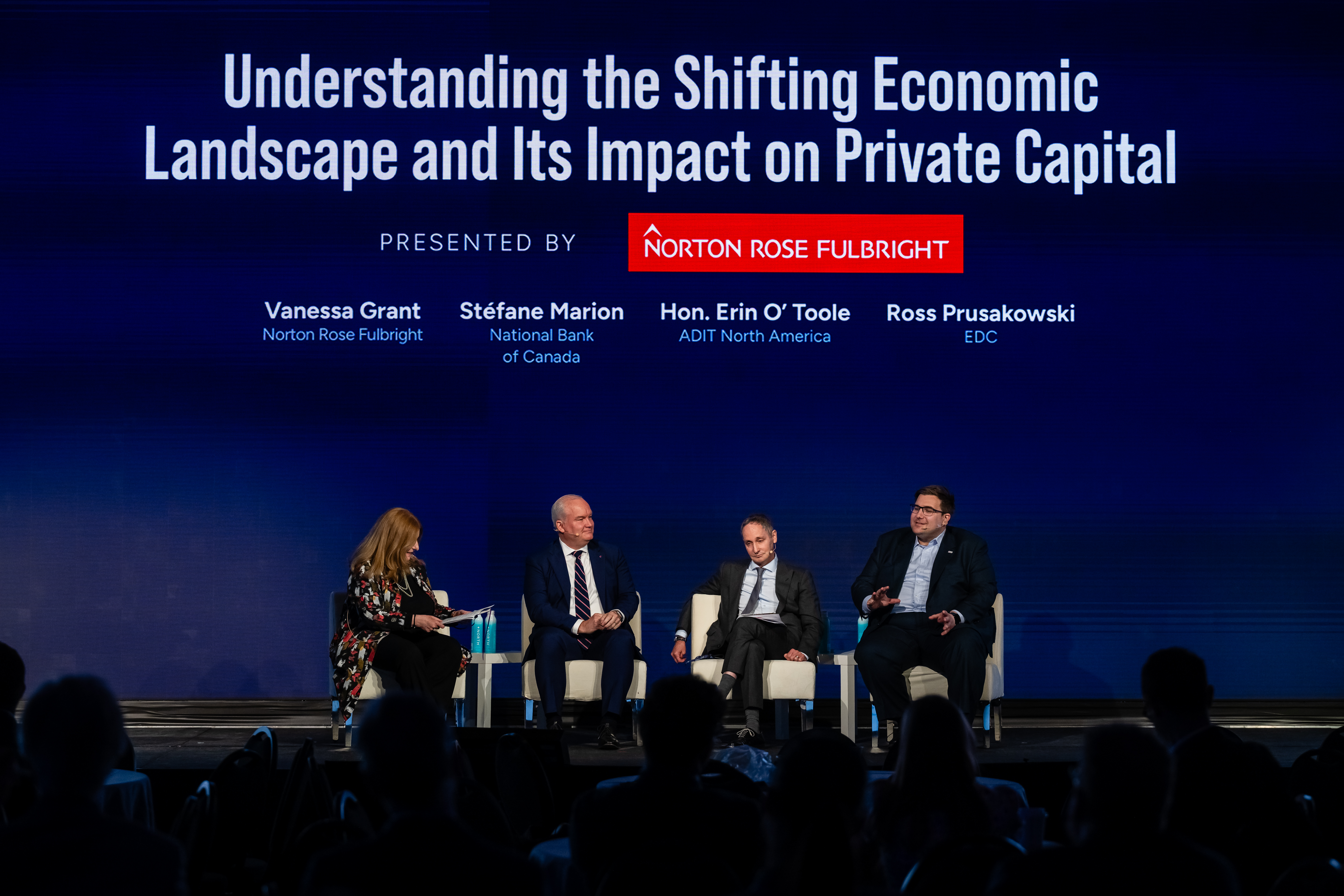
Global volatility and policy shifts are changing how private capital moves. These insights come from the Understanding the Shifting Economic Landscape and Its Impact on Private Capital mainstage session at Invest Canada ’25 in Calgary, presented by Norton Rose Fulbright.
The Understanding the Shifting Economic Landscape and Its Impact on Private Capital session at Invest Canada ’25 in Calgary, presented by Norton Rose Fulbright on the mainstage, delivered a frank, data-informed discussion about how global volatility and structural shifts are reshaping capital deployment strategies. Panelists provided a focused lens on how investors can strategically adapt to evolving conditions, both at home and abroad.
Stéfane Marion, Chief Economist and Strategist at National Bank, opened with a macroeconomic reality check. While Canada’s overall GDP growth has outperformed expectations, Marion emphasized that these gains do not hold up when viewed on a per capita basis. Growth, he explained, is now largely a function of population increases, not productivity. That shift raises red flags for long-term domestic returns. For private capital managers focused on the Canadian market, it underscores the importance of adjusting growth assumptions to account for structural inefficiencies.
Marion also pointed to the growing divergence between U.S. and Canadian monetary policy. The U.S. economy’s relative resilience has kept the Federal Reserve cautious about cutting rates, maintaining higher levels for now despite growing political pressure to ease. In contrast, Canada’s household leverage constraints may push its central bank to move sooner, widening the policy gap. This split puts downward pressure on the Canadian dollar and may create valuation frictions for Canadian firms seeking U.S. investment or customer acquisition. As Marion noted, investors can no longer assume macro conditions are aligned across borders. Capital pacing and portfolio decisions must be recalibrated accordingly.
Ross Prusakowski, Deputy Chief Economist at EDC, explored how trade policy shifts are accelerating decoupling across economies. Protectionist measures in the U.S., especially in sectors deemed strategic, are forcing Canadian firms to reassess exposure risk. Prusakowski flagged a shift in investor diligence, with a growing focus on the potential for future policy shocks rather than just current regulatory environments. This dynamic is influencing deal structure, valuations, exit strategies, and partner selection.
The conversation then turned to institutional trust and macro stability with Hon. Erin O’Toole, President and Managing Director of ADIT North America. Drawing on his public and private sector experience, O’Toole made a pointed case for the role of political stability and policy clarity in attracting capital. He warned that inconsistent signals from government, or the perception of reactive politics, can erode investor confidence. Institutional trust, he argued, is now a front-line input into allocation decisions.
Panelists also addressed shifting LP behaviour. Fundraising timelines are stretching. LPs are approaching re-ups with caution and are scrutinizing fund pacing and size assumptions more aggressively. Liquidity constraints, particularly in venture, are moving allocators toward strategies that either provide near-term cash flow visibility or show alignment with long-term structural trends. The message was clear: investor expectations are evolving fast, and GPs must match that evolution with clarity and macro fluency.
The panel surfaced several strengths Canada can leverage. Marion referenced the country’s robust banking system as a source of resilience. Prusakowski pointed to untapped trade corridors beyond the U.S. as diversification opportunities. O’Toole emphasized Canada’s human capital and institutional quality, which continue to be strong advantages, especially when paired with disciplined regulation.
Throughout the session, one theme prevailed: deliberate recalibration. Optimism, while important, is not enough. Forecasts must be grounded in geopolitics and macroeconomic realities. GPs who show discipline, macro awareness, and fluency in investor language are more likely to retain confidence.
As the discussion closed, panelists made clear that this moment is not about retreat, but about strategic evolution. Capital is still flowing, but it is flowing differently. For private capital firms, staying aligned with the realities facing LPs across geographies, asset classes, and timelines will be key to maintaining trust and performance.
The path forward will demand realism, adaptability, and greater awareness of the signals investors are using to shape decisions. Those who move with the moment will lead it.
Since 1979, Invest Canada has been where Canada’s private capital community comes together to build relationships, close deals, and share real-world experience. It’s the definitive forum for GPs and LPs to connect, collaborate, and uncover new opportunities. Learn more at conference.cvca.ca.