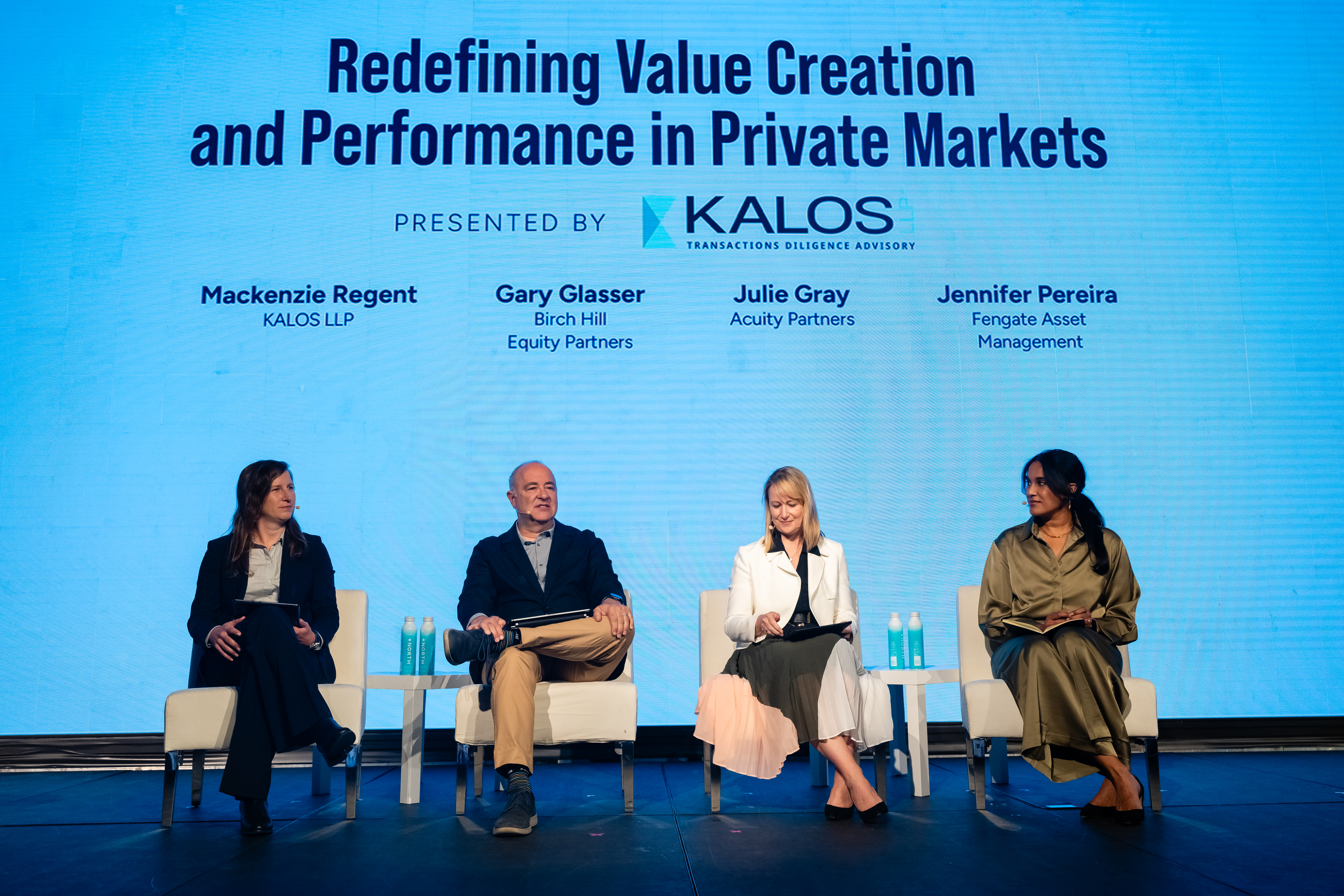
At Invest Canada ’25, a main stage discussion presented by KALOS LLP examined how private capital firms are rethinking value creation in a more operationally demanding market. The conversation focused on how firms are building the capabilities needed to translate strategy into measurable results.
At Invest Canada ’25, the main stage discussion, Redefining Value Creation and Performance in Private Markets, presented by KALOS LLP, took a close look at how private capital firms are rebuilding their approach to value creation. The session focused less on high-level frameworks and more on the mechanics that drive measurable impact today.
Across the conversation, it became clear that the current environment demands GPs who can move beyond traditional oversight and bring operational credibility to each investment. One view that emerged strongly was that building in-house capability is no longer optional. Some firms are no longer outsourcing functional support. Instead, they are building dedicated internal teams focused on operational transformation. These teams often have embedded roles in talent, systems, finance, and execution. What used to be the work of external consultants is increasingly a core function of the GP itself. This shift is allowing some firms to replicate success more consistently and scale their value creation strategy without relying on relationships outside the fund.
Another major thread focused on how GPs establish working partnerships with founders and portfolio leadership. Participants emphasized that operational involvement rarely begins in the boardroom. It develops when founders see investors engaging with the business itself, spending time with leadership teams, understanding operational constraints, and contributing beyond financial oversight. The strongest results came from firms that approached founder relationships with patience and humility. Rather than issuing mandates from the boardroom, these GPs created space for founders to engage when ready. In several cases, firms earned deeper operational access not by leading with expertise, but by supporting through moments of transition and listening when momentum stalled.
This founder-GP alignment was flagged as a key differentiator in outcomes. Where the relationship felt top-down or transactional, portfolio performance tended to lag. In contrast, where GPs had taken the time to understand leadership dynamics and adapt their support accordingly, outcomes were more stable, and value creation efforts took root earlier in the investment cycle.
Ownership structure also affects how value creation can be implemented. Buyout strategies typically benefit from majority control, allowing firms to move more directly on operational change. In minority or growth investments, the GP’s role is more about influence than control. Operational initiatives therefore depend more heavily on founder alignment and management buy-in.
A recurring observation from the conversation was that data is a supporting tool, not a solution. Several participants warned against leaning too hard on dashboards or metrics at the expense of judgment. Portfolio reviews that focused only on lagging indicators often missed early signs of friction or drift. Some firms have evolved their data strategies to include both quantitative and qualitative inputs, blending operational analytics with in-field insights gathered through regular engagement.
In terms of LP expectations, value creation has now become a formal category in diligence. LPs are asking for more than narratives. Some are requesting documentation showing how value was built, how outcomes were tracked, and how lessons from prior investments are being applied to current strategies. That includes case-based evidence of failed initiatives and how those lessons were integrated into firm-level processes. There was wide agreement that LPs are looking for consistency and institutional learning, not perfection. When GPs avoid the hard questions or downplay operational setbacks, it raises concerns about whether the playbook actually exists or is just post-rationalized.
Participants also raised the need to reassess how exit timing is evaluated. In today’s extended hold environment, firms cannot rely on market conditions to signal readiness. Instead, readiness is being defined by internal alignment. That includes governance stability, reporting discipline, leadership continuity, and operational scalability. GPs are beginning to treat exit prep as an investment in its own right. In some cases, firms have started building toward exit conditions from day one, rather than reacting once a window opens.
There was also a caution against viewing value creation as a siloed activity. Some GPs still operate under the assumption that portfolio support sits in a separate box from investment or capital markets. The discussion challenged that view. In the current market, operations, capital strategy, and talent architecture are often intertwined. Firms that fail to integrate these dimensions across their teams risk fragmentation and missed signals. In more integrated models, portfolio support teams work closely with deal teams and leadership advisors to apply firm-level insight directly to company-level execution.
Lastly, one message that resonated across the conversation was that value creation is now a core part of firm identity. For many LPs, it is no longer enough to show a strong return profile. They are looking for process maturity, operating leverage, and organizational depth. GPs that treat value creation as a differentiator only at fundraising are unlikely to meet that standard. Those that treat it as a discipline across the entire lifecycle, from sourcing to exit, are finding that they are better positioned both in performance and perception.
GPs must now prove that they can lead through uncertainty, execute with consistency, and back that execution with evidence. For those who can, value creation is becoming a driver of not just returns, but of ongoing access to capital.
Since 1979, Invest Canada has been where Canada’s private capital community comes together to build relationships, close deals, and share real-world experience. It’s the definitive forum for GPs and LPs to connect, collaborate, and uncover new opportunities. In 2026, the Invest Canada conference will be taking place in Halifax, May 26-28. Learn more here.