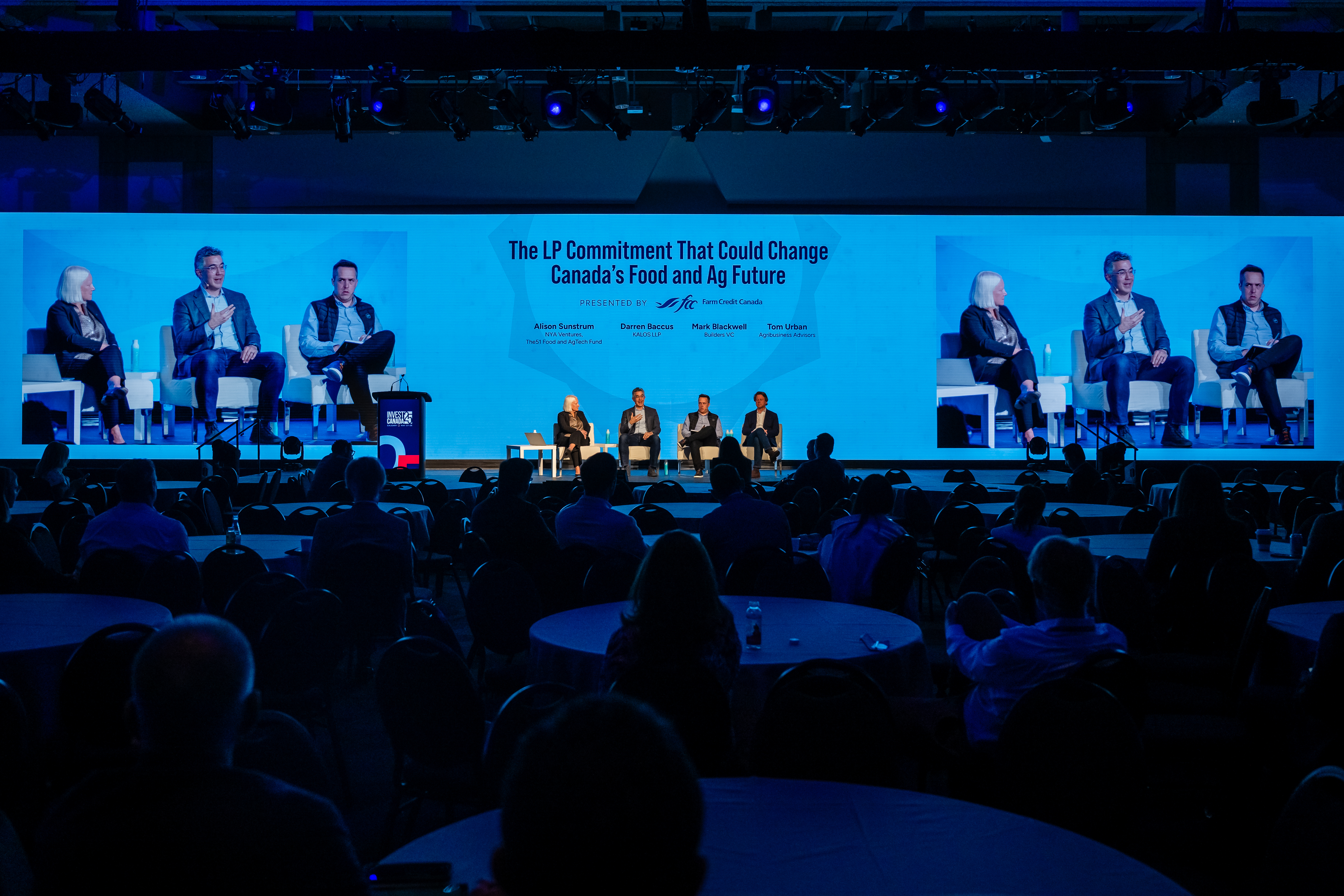
At Invest Canada ’25, a session presented by Farm Credit Canada focused on the gap between agriculture’s economic weight and its share of private capital. The discussion centered on how to make food and ag investable at scale, and what catalytic capital must actually deliver.
At Invest Canada ’25, a pivotal session on the future of Canada’s agriculture and food economy highlighted the urgent need for greater capital participation in one of the country’s most strategic sectors. Sponsored by Farm Credit Canada (FCC), the panel convened leading voices from across venture and private equity to discuss the intersecting forces of innovation, capital allocation, and national competitiveness. The session also served as the public unveiling of a $2 billion commitment by FCC to support ag and food innovation through its newly launched investment arm, FCC Capital. The commitment aims to help catalyze investment across the full value chain, from pre-seed to growth-stage companies and investment funds, between now and 2030.
The session quickly moved beyond the announcement to interrogate what catalytic capital really means, and what it will take to make the sector investable at scale. Despite representing roughly 7% of GDP and employing more than 2 million Canadians, agriculture attracted 3.57% of total Canadian venture capital dollars in 2025 and 0.93% of private equity dollars, according to CVCA’s 2025 Year-End Market Reports. While some large-scale family offices and a few sector-specific funds have long played in the space, most generalist firms have remained on the sidelines. Risk models are often not adapted to the seasonal, cyclical, and infrastructure-heavy nature of food and ag investment.
One panelist noted that deal quality is not the issue. The problem is fragmented value chains and unclear entry and exit points. Investors with experience in SaaS or healthcare are accustomed to linear adoption curves and comparable metrics. Without enough real farm trial capacity, promising approaches stall before they generate the kind of evidence investors and buyers will accept.
Speakers underscored the need to stop treating agriculture as a monolith. The sector includes everything from indoor vertical farming and autonomous tractors to climate-resilient inputs and biotechnology for livestock health. Different areas carry different risk profiles, and success depends on knowing what you’re underwriting.
Another participant emphasized that food and ag investing should not be viewed only through the lens of climate or sustainability, though both are major value drivers. Some of the most attractive innovations are targeting productivity, logistics, and upstream traceability. Investors looking only for “green” labels may miss compelling bets that are less visible but no less transformative.
One theme that recurred was the need for better collaboration between institutional and private capital. FCC’s commitment was positioned not as a replacement for private investment but as a lever to unlock it. Several attendees noted that Canadian LPs have traditionally viewed agtech as niche or overly specialized. With a scaled institutional player now anchoring the space, other actors may follow.
The value of co-investment was also raised. When firms with deep sector expertise co-invest with institutional capital, they de-risk early-stage bets and validate quality. A few panelists suggested that private equity firms may find opportunities in platform rollups or downstream logistics, particularly as infrastructure modernization becomes more urgent.
Despite the optimism, there was also candid reflection on the structural challenges. Canada still lacks the density of accelerators and applied R&D hubs seen in places like the Netherlands or the American Midwest. In one discussion, it was noted that talent retention in ag innovation is a real concern. Top technical talent often migrates to adjacent industries with better access to capital and fewer supply chain constraints.
Another topic was market access. A speaker highlighted that Canadian agtech firms often struggle to break into international markets due to procurement cycles, trade barriers, or complex compliance regimes. The point was made that capital alone will not be enough unless paired with support mechanisms that help scale commercial deployment. One panelist called for better data infrastructure to support export-readiness and policy advocacy, which in turn helps attract capital with longer timelines.
A more practical observation came when the conversation turned to regulatory burdens. Licensing, cross-border certifications, and food safety protocols all introduce complexity, particularly for earlier-stage companies. Regulatory support was identified as one area where FCC and other stakeholders can influence policy or streamline pathways through targeted partnerships.
One of the most widely agreed-upon points was that agriculture and food innovation cannot be treated as a domestic conversation only. Speakers pointed to geopolitical shifts, food security tensions, and energy supply risks that are reshaping global agriculture priorities. Food security was framed explicitly as a sovereignty issue. Canadian capital allocators need to consider how the sector fits into broader resilience and national security narratives.
The conversation returned repeatedly to the idea that capital flows shape what gets built. FCC’s announcement was not viewed as an endpoint but as a call to action. In an ecosystem where most GPs and LPs have looked for predictable growth curves and fast exits, food and ag investing requires a different playbook. It demands investors who understand systems thinking, and who are willing to learn from failure without exiting the category.
A few speakers cautioned that momentum is easy to lose. When early initiatives are not paired with patient capital or technical support, they fall short. The most effective models, they argued, create feedback loops where private capital, government funding, and corporate participation reinforce each other rather than competing for visibility or deal access.
By the close of the session, the tone was clear. Canada has the talent, the research infrastructure, and the market potential to lead globally. What has been missing is sustained capital deployment that recognizes the strategic importance of this sector. FCC has now set a benchmark. It is up to the rest of the market to respond with action, not just optimism.
Since 1979, Invest Canada has been where Canada’s private capital community comes together to build relationships, close deals, and share real-world experience. It’s the definitive forum for GPs and LPs to connect, collaborate, and uncover new opportunities. In 2026, the Invest Canada conference will be taking place in Halifax, May 26-28. Learn more at conference.cvca.ca.