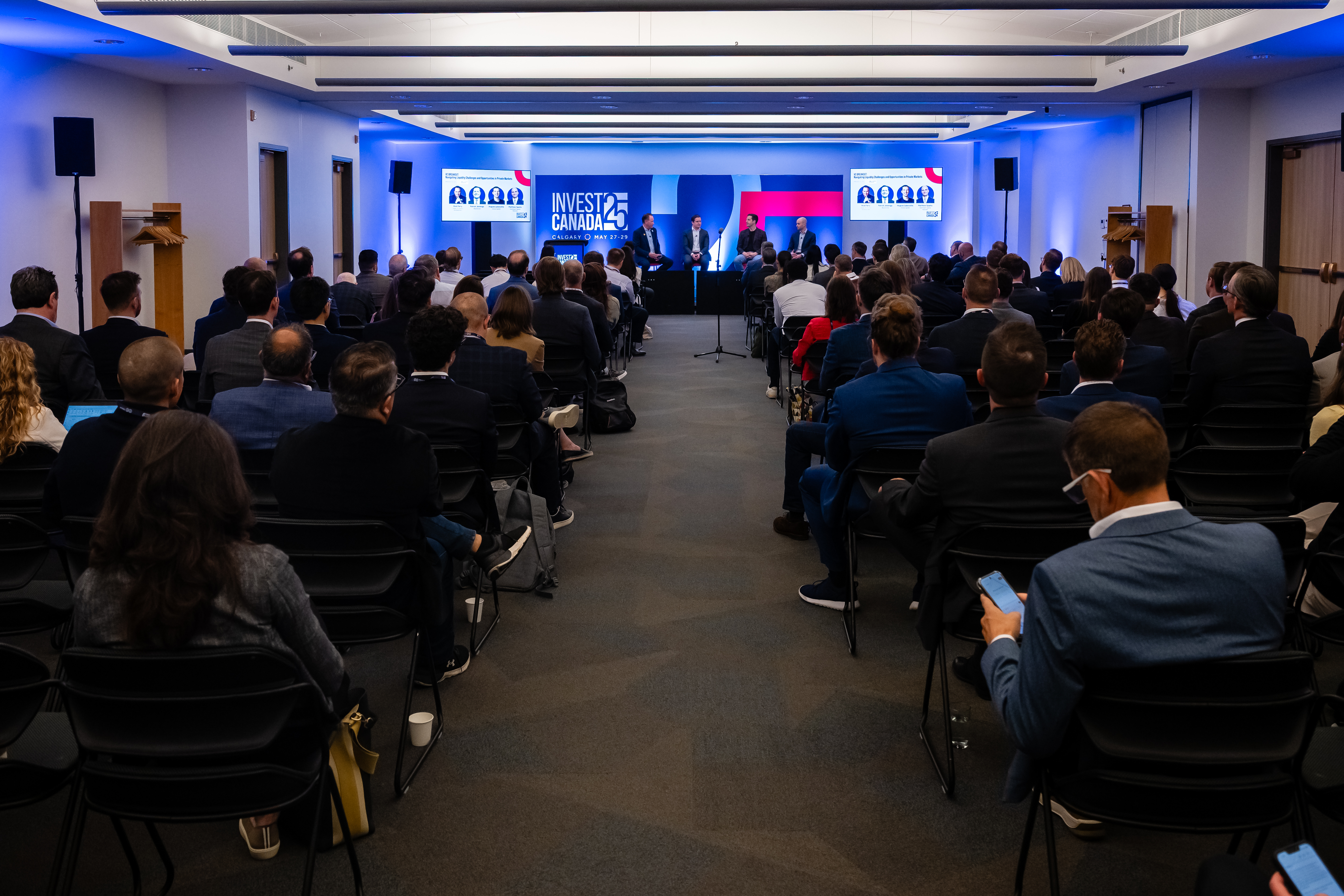
Liquidity has become a design challenge rather than a passive outcome. At Invest Canada ’25, in a session presented by Calgary Economic Development, participants examined how secondaries, continuation funds, and more deliberate exit planning are reshaping private market strategy as timelines stretch and traditional liquidity paths remain uncertain. The discussion focused on how GPs are being forced to actively engineer outcomes in order to meet evolving LP expectations.
Liquidity constraints are forcing GPs to rethink how they create value for LPs. That was the starting point for a session focused on secondaries, continuation funds, and the search for liquidity in today’s private markets. The session, moderated by a senior leader from Calgary Economic Development, brought together experienced voices across venture, growth, and institutional capital.
One of the most consistent messages from the panel was that liquidity is no longer a natural outcome of performance. GPs must now actively engineer exits in a market where timelines have stretched and valuations are harder to reconcile across buyers and sellers.
A representative from a global alternative asset manager highlighted the scale of the issue. Their group saw over 1,400 liquidity solutions last year. While not all were acted on, the number alone shows how dramatically the market has shifted from the days of automatic IPOs or quick M&A outcomes.
Another panelist noted that LPs are still allocating to venture and growth, but expectations around distributions have changed. The idea of waiting a decade without meaningful liquidity is less tolerable. GPs need to think more seriously about structured outcomes and communication around timing.
One strategy gaining momentum is the continuation fund. It offers a way to recapitalize existing assets while providing liquidity to legacy LPs and creating fresh alignment for the GP. The panel acknowledged that these structures are difficult to execute well. They require strong governance and a clear rationale. LPs are cautious, and rightfully so. Misalignment can arise when the GP is the one proposing the transaction and also benefits from it.
Still, the potential is there. When used appropriately, continuation funds can help GPs hold on to high-performing assets that would otherwise be sold early due to fund mechanics. One speaker mentioned the risk of “selling your winners too soon,” and continuation structures are a direct response to that problem.
Secondaries were another area of focus. GP-led secondaries have grown rapidly, but the market has matured and become more disciplined. What was once seen as a rescue option is now part of normal portfolio management. Investors are more selective and pricing is under more scrutiny.
One panelist, who leads secondaries for a large private capital firm, outlined where deals are getting done. Continuation funds with concentrated portfolios and proven growth are seeing real activity. Deals based on hope, or where pricing is too aggressive, are not moving forward. Price discovery is a recurring challenge. There is a valuation disconnect that continues to weigh on the market.
Venture capital, in particular, is navigating a more difficult pricing environment. Some managers are taking marks too slowly. Others are still holding onto 2021 valuations. That creates friction in secondaries. Buyers are cautious. They want to underwrite to real cash flow or see a clear exit within the next cycle.
For growth equity and larger funds, a senior investor shared that they are spending more time with management teams to understand how they would perform through a sale. Exit readiness has become a core diligence item. It is not just about the metrics on paper. It is about the actual probability of an outcome.
The discussion also touched on geographic trends. While some GPs in Canada are successfully navigating the new landscape, others are still waiting for market conditions to return to what they were. The speakers were clear that those conditions may not return any time soon. GPs need to make decisions based on today’s environment rather than waiting for a recovery that may take years.
Another comment that resonated with the audience was around communication with LPs. One investor observed that some GPs are being too quiet. They are not proactively updating LPs about how they are thinking through exits. This silence creates discomfort. It leaves room for assumptions. In today’s environment, over-communicating is better than waiting for perfect certainty.
A related issue is around fund terms. There is tension between keeping assets that are growing and respecting the original fund mandate. LPs want returns, but they also want liquidity. Structuring solutions need to acknowledge that tension. It is not just about generating DPI, but also about how that DPI is created.
When asked about what has worked, panelists agreed that there is no one-size-fits-all answer. What works in one sector or stage may not apply in another. What matters is that GPs are willing to be transparent, responsive, and pragmatic. Solutions exist, but they require trade-offs.
The session ended with a look ahead. Most panelists expect a slow and uneven recovery in exit markets. They advised peers to stay focused on portfolio quality and optionality. GPs should build toward multiple potential paths to liquidity rather than rely on a single scenario.
The underlying message was clear. Liquidity is no longer a backend function of investing. It is now a strategic capability. Firms that can deliver it thoughtfully will stand out. Those that cannot risk losing trust, capital, and eventually relevance.
As one participant put it, the job has become harder, but that does not mean the opportunity is gone. It just means the playbook has changed.
Since 1979, Invest Canada has been where Canada’s private capital community comes together to build relationships, close deals, and share real-world experience. It’s the definitive forum for GPs and LPs to connect, collaborate, and uncover new opportunities. In 2026, the Invest Canada conference will be taking place in Halifax, May 26-28. Learn more at conference.cvca.ca.