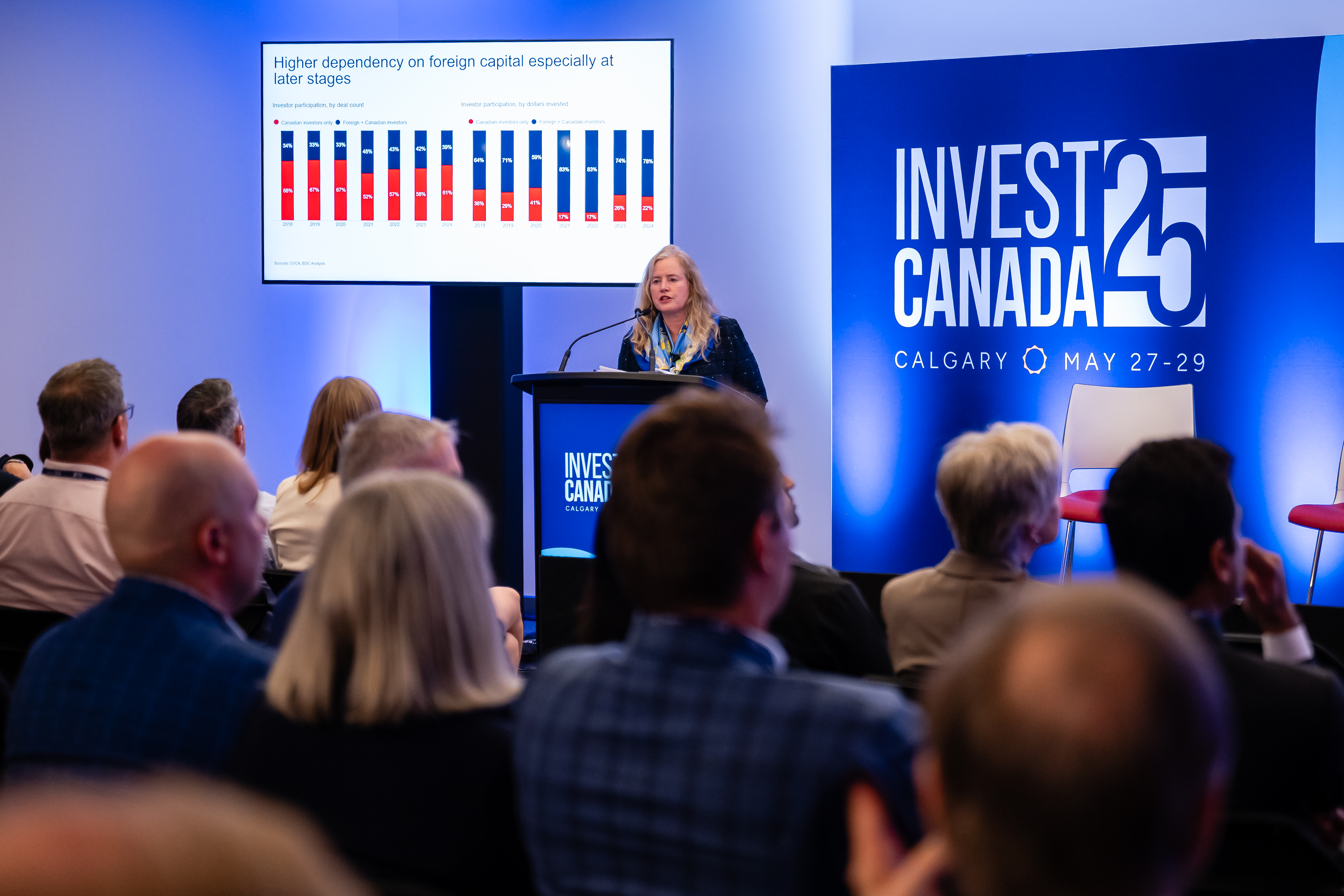
At Invest Canada ’25, a GP-only session examined where Canada’s private capital market stands in the current cycle and what it demands of fund managers navigating tighter liquidity, shifting LP expectations, and a heavier reliance on foreign capital than the ecosystem can comfortably absorb.
The GP-only session on Canada’s evolving private capital landscape at Invest Canada ’25 covered fresh data on capital availability, liquidity trends, and market cycles, and it did not shy away from the pressures facing fund managers and founders alike.
Total investment dollars in Canadian venture are up compared to last year, reversing two consecutive years of decline. But deal volumes are down while cheque sizes are up, meaning a smaller pool of companies is capturing larger rounds. That pattern tracks with global post-pandemic dynamics, though Canada carries a specific vulnerability: heavy reliance on foreign capital, particularly at later stages. Participation from key foreign markets has already dropped by several percentage points, and with trade policy, tariffs, and fiscal uncertainty still unresolved, that exposure has not gone away.
Liquidity dominated much of the conversation. Canada now has more than two dozen unicorns but exits remain scarce. Private companies are staying private longer, secondaries are not meaningfully absorbing pent-up demand, and LPs under pressure to show DPI are sitting on extended timelines. Canadian secondary volumes are estimated near $800 million, which is not enough to move the needle on the broader gap.
LP-GP dynamics are shifting in response. Fewer LPs are deploying, but those who are writing larger cheques and concentrating commitments with managers they trust. That creates advantages for established GPs and raises the bar for everyone else.
Founders are navigating longer gaps between raises, with Series A to B now averaging close to three years. Fund managers are in the same position, with the average time between fundraises stretching from three to four years. Those extended cycles put pressure on how managers pace deployment and structure portfolios, and they make staying aligned with LP expectations harder across the board.
The group spent time on historical cycles, and the read was consistent: periods of contraction and low liquidity have often produced the strongest fund vintages. Disciplined deployment in difficult markets has historically driven long-term returns. Some panelists cautioned against chasing early DPI at the expense of larger later-stage outcomes, while others acknowledged that smaller funds operating in tight capital conditions may not have that luxury.
Comparisons to global markets drew debate. Canada’s ecosystem is still earlier in its development relative to mature peers, and benchmarking against the US without accounting for institutional timelines obscures more than it reveals. Several participants pointed to the UK as a more relevant comparison for assessing progress on capital scaling and liquidity.
Corporate venture remains a gap. Canadian corporates invest in private capital at significantly lower rates than international counterparts, which means a potential source of diversified, domestically anchored capital is largely sitting out.
The overall read was cautious but not pessimistic. Market cycles have a pattern, and the next five to eight years were described as pivotal. If scaled Canadian companies can deliver meaningful exits, the conditions for a more mature, stable capital ecosystem follow. If they cannot, the combination of foreign capital pullback, liquidity gaps, and underfunded later stages compounds.
For GPs, the practical takeaway was direct: the current environment is not just a deployment question. Pacing, LP alignment, and portfolio structures built for prolonged timelines are what determine who comes out well on the other side.
Since 1979, Invest Canada has been where Canada’s private capital community comes together to build relationships, close deals, and share real-world experience. It’s the definitive forum for GPs and LPs to connect, collaborate, and uncover new opportunities. In 2026, the Invest Canada conference will be taking place in Halifax, May 26-28. Learn more here.