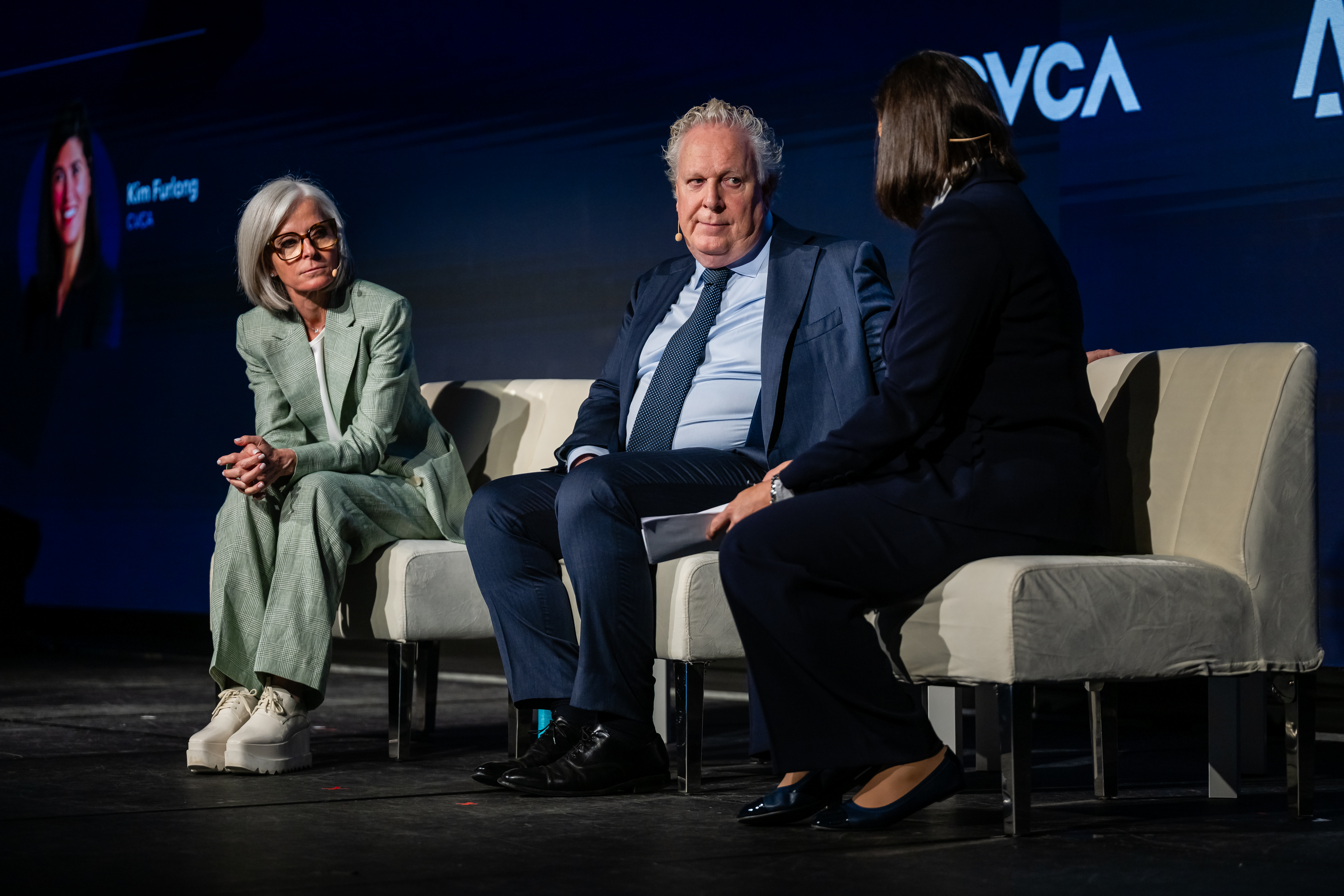
At Invest Canada ’25, a main-stage session, presented by BDC, told a room of investors that Canada’s economic challenges are directional and that the assets needed to close the gap are already in place.
At Invest Canada ’25, a main-stage discussion between Jean Charest and Isabelle Hudon explored Canada’s position in an increasingly unstable global economy. The session, presented by BDC, brought urgency to questions that are often sidestepped in national discourse. Both speakers, drawing from long careers in government, diplomacy, and institutional leadership, delivered a pointed critique of Canada’s economic posture and the limited coordination currently shaping policy and private investment. While the audience included many in venture and private equity, the session focused on the conditions that either unlock or suppress its impact.
Charest opened with a direct assessment. Canada holds rare trade positioning, with access to the US, Europe, and Pacific markets. Yet few Canadians understand just how dependent the economy is on trade. He argued that this advantage is being squandered. There is no clear strategy, no unified industrial policy, and no political urgency to set direction. The result is a drift, while other countries act with more clarity and speed.
Hudon brought that critique into the operational realities of founders and funders. She pointed to a “crisis of confidence” among Canadian entrepreneurs, many of whom are contending with not only capital constraints but also the absence of coherent national signals. Without clear policy frameworks or cross-institutional collaboration, founders feel unmoored. Hudon noted that the lack of a shared economic direction discourages ambition, which becomes a structural drag on growth.
A thread ran through both speakers’ comments. Canada has talent. It has institutions. It has financial stability and natural assets. But these strengths are not being directed with sufficient focus. Charest questioned whether there is even an appetite among decision-makers to do what is necessary to compete in the current environment. He cited Canada’s early AI leadership as a missed opportunity: technical breakthroughs were not followed by the procurement, infrastructure, or scale-up strategies needed to turn them into economic leadership. The window opened. Other countries moved while Canada paused.
Hudon pressed on this point. In her view, the gap is not in capacity, but in coordination. Too many initiatives are siloed and frequently without clear signals from the top. She emphasized that policy certainty, not perfection, is what drives institutional investment. Delays in regulatory timelines or unclear program objectives introduce friction into systems that depend on predictability.
Both speakers described conditions as they are: fragmented, reactive, and increasingly exposed to external shocks. Charest spoke about geopolitical blocs forming without Canada’s active participation. He warned that neutrality is not a viable strategy in a world realigning around interests. Hudon echoed this, arguing that even domestic policy must now be shaped with external dynamics in mind. Canada cannot lead if it does not show up, and showing up means knowing what you want to accomplish.
One undercurrent throughout the conversation was the role of culture. Charest described a political culture that avoids naming trade-offs. Hudon described an institutional culture that confuses caution with discipline. She pushed back on the idea that entrepreneurs lack ambition. Too often, systems available send mixed messages or fail to respond with the speed that today’s global competition requires.
Both also touched on the private sector’s role. Charest argued that institutional investors, including GPs and LPs, have a responsibility to speak clearly about what they need from government. He said silence has become a liability. Hudon agreed and called for more assertiveness from private actors. The notion that the public sector must move first is no longer realistic. Investors, especially those with long-term mandates, need to step into the vacuum and define expectations.
BDC’s own role came up as an example of what coordinated, sector-specific work can look like. Hudon described BDC’s efforts in cleantech and artificial intelligence as a way to signal long-term commitment to areas where Canada has potential. But she made clear that no single institution can carry that weight alone. Sustained competitiveness requires shared conviction across multiple actors.
Near the end, Charest addressed political leadership. Without identifying parties or individuals, he made the case that many of Canada’s current challenges are a result of inadequate or inconsistent leadership at senior levels. That vacuum, in his view, affects how seriously global markets take Canada’s economic positioning. Hudon reframed the same point as a challenge for this generation of institutional leaders. The tools exist. The capital exists. The missing element is conviction about where the country should go and the discipline to organize around that direction.
The message for private capital was unambiguous. Strategy is not a government problem alone. It is an operating condition for anyone deploying capital in this market. Waiting for clarity may no longer be an option. Leadership will have to emerge wherever it can, including from those who manage funds and shape investment ecosystems.
Charest closed the session with a simple warning. The world is not waiting for Canada to decide. Other countries are aligning policy, capital, and institutions to pursue national advantage. If Canada wants to compete, it must be equally clear about its priorities. If not, it will be forced to operate within a framework defined by others.
The lively discussion underscored the value of engaging beyond the deal level. Long-term returns depend not only on finding the right companies but also on pressing for the conditions that allow those companies to thrive. The call to action was a direct appeal to institutional investors to treat economic direction as a core concern.
Since 1979, Invest Canada has been where Canada’s private capital community comes together to build relationships, close deals, and share real-world experience. It’s the definitive forum for GPs and LPs to connect, collaborate, and uncover new opportunities. In 2026, the Invest Canada conference will be taking place in Halifax, May 26-28. Learn more here.