When South African–born Mark Skapinker first arrived in Canada in 1981, he was fascinated by the country’s emerging technology sector. Toronto, in particular, had become an early centre of innovation, with major companies like Commodore and Atari operating in the city alongside a growing network of entrepreneurs helping shape the personal computing revolution.
Eager to be part of that transformation, Skapinker joined a small company called Batteries Included as head of software development, a role that immersed him in both the Canadian tech community and the rapidly expanding software ecosystem in California. Inspired by the entrepreneurial opportunities he saw around him, he co-founded Delrina Technology in 1988.
Delrina’s flagship product, WinFax, allowed users to send and receive faxes directly from their computers, helping modernize office communications during the early days of personal computing. The company expanded rapidly: by 1993, Delrina had gone public on Nasdaq and TSX, generated hundreds of millions of dollars in revenue and employed more than 900 people. Recognizing that email would eventually replace fax communications, Skapinker sold the company to Symantec for US$415 million in 1995. At a time when domestic tech success stories were relatively rare, Delrina proved that globally competitive software companies could be built in Canada.
Skapinker’s next venture came in 1997 with the founding of Balisoft, a company focused on helping organizations use web-based tools to improve customer service. Backed by investors including La Caisse de dépôt et placement du Québec (CDPQ), Balisoft later merged with Servicesoft, a Boston software company, before being acquired by California-based KANA in 1999, further strengthening Skapinker’s reputation as both a tech entrepreneur and a cross-border connector.
“I was thinking about my next career move when some investors approached me with an idea,” recalls Skapinker. “There were very few venture capital firms in Canada at the time, and they suggested I take the experience I had gained building tech startups and apply it to investing. The opportunity to strengthen Canada’s venture capital sector and connect entrepreneurs across the country really resonated with me.”
From Entrepreneur to Venture Capital Builder
In 1999, Skapinker co-founded Brightspark Ventures. From the outset, he believed venture capital needed to operate as a national industry rather than a collection of regional silos. To build those nationwide connections, Skapinker set about rallying investors to his vision. Among the earliest supporters was Sophie Forest, then a rising star at La Caisse, who had previously backed Balisoft and quickly recognized the potential of Brightspark.
“When I first met Mark, I expected an intimidating, larger-than-life figure. Canada’s tech ecosystem was still in its infancy, and he was already something of a local legend because of the success of Delrina,” says Forest. “Instead, he was incredibly humble and approachable. What stood out was his confidence and ability to see opportunities before others did. Balisoft was ahead of its time, and that same visionary thinking made Brightspark an easy investment decision.”
Brightspark launched during a turbulent period for venture capital. The dot-com bubble was about to burst, leaving many investors wary of tech startups. Yet Skapinker remained convinced that breakthrough companies could only be built by embracing risk. His approach was to make ambitious bets while accepting that failure was an inevitable part of venture investing. Equally important was his ability to remain calm amid uncertainty, a quality colleagues say helped him navigate market upheaval and the emotional highs and lows that come with backing entrepreneurs.
“Part of what has shaped my approach comes from what I call an immigrant mentality,” says Skapinker. “When you arrive in a new country, you don’t bring much with you except your ambition and your willingness to adapt. The tech industry rewards people who are prepared to take risks because success and failure are often separated by very fine margins. Canada has benefited enormously from immigrants who have already experienced major change in their own lives, and I’ve always believed that gives our innovation sector a unique advantage.”
As Brightspark prepared to raise its second fund in 2003, Skapinker recruited Forest to join the firm as co-managing partner. Their partnership would shape the next two decades of Canadian venture capital. Over the following 23 years, Skapinker became a mentor to generations of founders, often described by his peers as a patient coach who remained committed to entrepreneurs through both successes and setbacks, providing perspective when it was needed most. He was equally intentional about developing talent within the industry, creating pathways for future leaders who would later go on to Canadian firms such as Mantella Venture Partners, Golden Ventures and Radical Ventures.
Along the way, Brightspark backed several notable Canadian successes, including Think Dynamics, a software company acquired by IBM in 2003, and Radian6, the social media monitoring platform purchased by Salesforce for US$326 million in 2011. Another was Montreal-based Hopper, the travel app founded by Frédéric Lalonde in 2007. Skapinker and Forest saw Lalonde as emblematic of the kind of founder they sought out and the ethos instilled at Brightspark: ambitious, resilient and determined to challenge established industries. Today, Hopper is valued at $5 billion. “Mark has the ability to step back, see the full picture, and give perspective when it actually matters,” says Lalonde. “We wouldn’t be where we are today without that kind of long-term support.”
The Enduring Impact of a Venture Capital Pioneer
Across 45 years in technology and venture capital, Skapinker has left an indelible mark on the culture and values of Canada’s booming innovation economy. For many founders and investors, he’s also a voice of wisdom, the conscience of the venture capital world. “On every board I’ve been on with Mark, his word is the final word,” says Duncan Hill, managing partner at Mantella Venture Partners. “Not because he’s forceful, but because he’s trusted. He always does the right thing, even if it’s not entirely in his own self-interest.”
Skapinker’s legacy is also that of an advocate for diversity and inclusion in venture capital, championing those values long before they became industry priorities. Beyond investing, he has consistently viewed venture capital as a tool for building stronger institutions and communities. That philosophy inspired him to help create the Upside Foundation of Canada in 2013. The nonprofit encourages entrepreneurs to pledge a small percentage of their startup equity to charity, ensuring that future business success can also generate social impact. The model has attracted participation from some of Canada’s most successful founders, including Wealthsimple’s Michael Katchen and Wattpad co-founders Allen and Eva Lau.
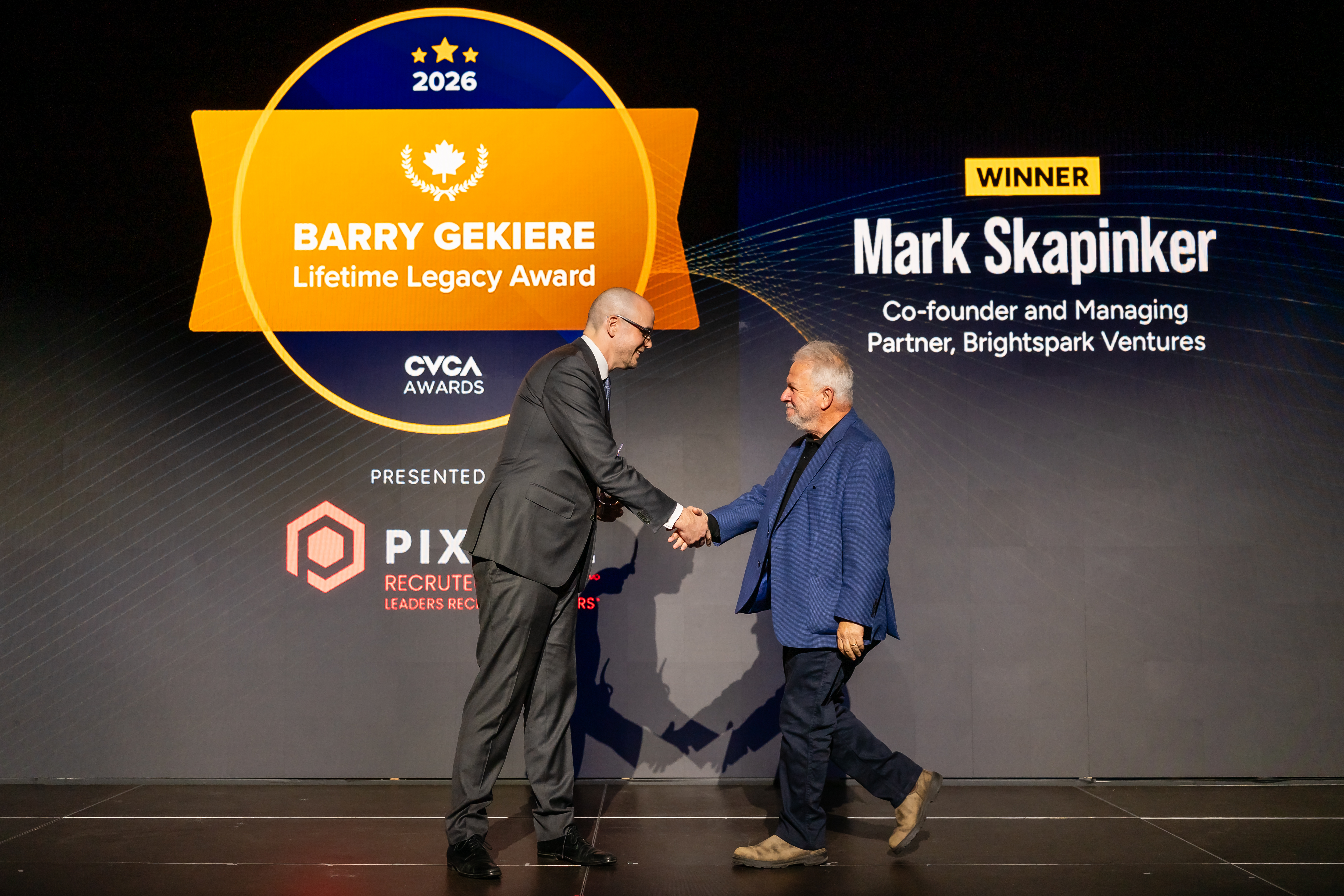
Taken together, those contributions as an entrepreneur, investor, mentor, institution builder and community leader make Skapinker a fitting recipient of the Barry Gekiere Lifetime Legacy Award, sponsored by PIXCELL . “I’m incredibly proud of what I’ve built at Brightspark and to have your peers recognize that work is deeply meaningful,” he says. “Barry Gekiere was someone I was fortunate to work with and learn from. He was a wonderful person and the fact that this award carries his name makes it mean something entirely different to me than any other recognition could.”
Nowadays, Skapinker’s attention is focused on ensuring Brightspark has the leadership it needs for the future. He has gradually stepped back from operational responsibilities to mentor the younger partners who are becoming the next generation of venture capital leaders. Yet even as he transitions away from managing the firm directly, his influence continues to ripple across the industry.
“Fred Lalonde leads one of the largest tech companies in Canada, and I work closely with him through my role on Hopper’s board,” says Forest, who remains co-managing partner at Brightspark. “When we’re discussing a challenge or an opportunity, one question often comes up: ‘What would Skapinker say?’ That’s a guiding question many founders in Canada will continue to ask for years to come.”