When electrical engineers Mohsen Asad and Hossein Fariborzi were students together in Iran, they often talked about a shared ambition: building a company that could one day transform the tech world. Although they eventually pursued their doctoral studies in different countries—Mohsen at Canada’s University of Waterloo and Hossein at MIT in the United States—the two remained close friends and continued exchanging ideas.
By the early 2020s, the rapid rise of AI revealed what they believed was one of the most significant bottlenecks in modern computing. As companies such as OpenAI and Anthropic built increasingly sophisticated AI models, the challenge was no longer simply generating more computing power. It was moving the vast amounts of data that those systems process quickly and efficiently.
Data centres heavily rely on copper cables to move data throughout their infrastructure. However, copper connections have limitations. They produce considerable heat and consume enormous amounts of electricity, creating both cost and performance issues as AI workloads become larger and more complex.
Mohsen and Hossein believed they had a solution. The founders envisioned replacing copper cables with specialized microLED optical interconnects that use light to transmit information. The result would be faster communication speeds and lower energy consumption, helping eliminate critical constraints that threaten to impede the next generation of AI infrastructure.
The idea drew directly on their complementary expertise. Mohsen specialized in optics, while Hossein’s background was in low-power electrical circuit design. In 2022, they combined those skill sets to launch Hyperlume, an Ottawa-based deep tech startup focused on reimagining how data moves inside AI data centres.
The next step then became finding an investor willing to support a technology that could take years to commercialize. “Deep tech companies require a different kind of investor,” says Mohsen. “Deep tech products aren’t built and released in a matter of months. You need partners who are patient, understand the technology and share the long-term vision of what you’re trying to achieve.”
From Deep Tech Vision to Market Reality
In 2021, a year before Hyperlume was founded, the Business Development Bank of Canada (BDC)’s investment arm, BDC Capital, launched the Deep Tech Venture Fund. The $200 million fund was created to address a major gap in Canada’s venture capital ecosystem by providing financing to deep tech companies that often struggled to attract investors.
“In addition to the normal business risks every startup faces, deep tech companies also carry substantial technology risk,” explains Duncan Stewart, partner at BDC Capital. “A software company generally knows it can build its product, so its primary question is whether customers will want it. Deep tech companies building physical products face an additional hurdle: proving that the underlying innovation can actually work at commercial scale.”
Hyperlume fit the fund’s profile perfectly. Stewart and his partner Charles Lespérance met Mohsen and Hossein in 2023 and were impressed by their technology and their ambition. For Hyperlume, BDC brought much more than capital. “They understood the realities of building a deep tech company and had a network of talent, suppliers and potential customers we could tap into,” says Mohsen. “They also challenged our thinking and helped us evaluate different market opportunities. Over time, a strong level of trust developed between us.”
The relationship culminated in BDC Capital leading Hyperlume’s US$12.5 million early-stage financing round in 2024 along with Canadian investors ArcTern Ventures (Toronto) and UCeed (Calgary), as well as U.S.-based Intel Capital, LG and SOSV. Following the investment, Hyperlume shifted into execution mode. With BDC Capital’s support, the company’s team expanded from the two co-founders to a staff of 20, recruiting talent from leading Canadian universities and signing deals with international manufacturing partners to support chip production. The results came quickly. While many startups in the sector are fortunate to bring one or two market-ready chips to fruition in a year, Hyperlume successfully developed three within a 12-month period and secured a roster of customers across North America.
A Canadian Success Story Goes Global
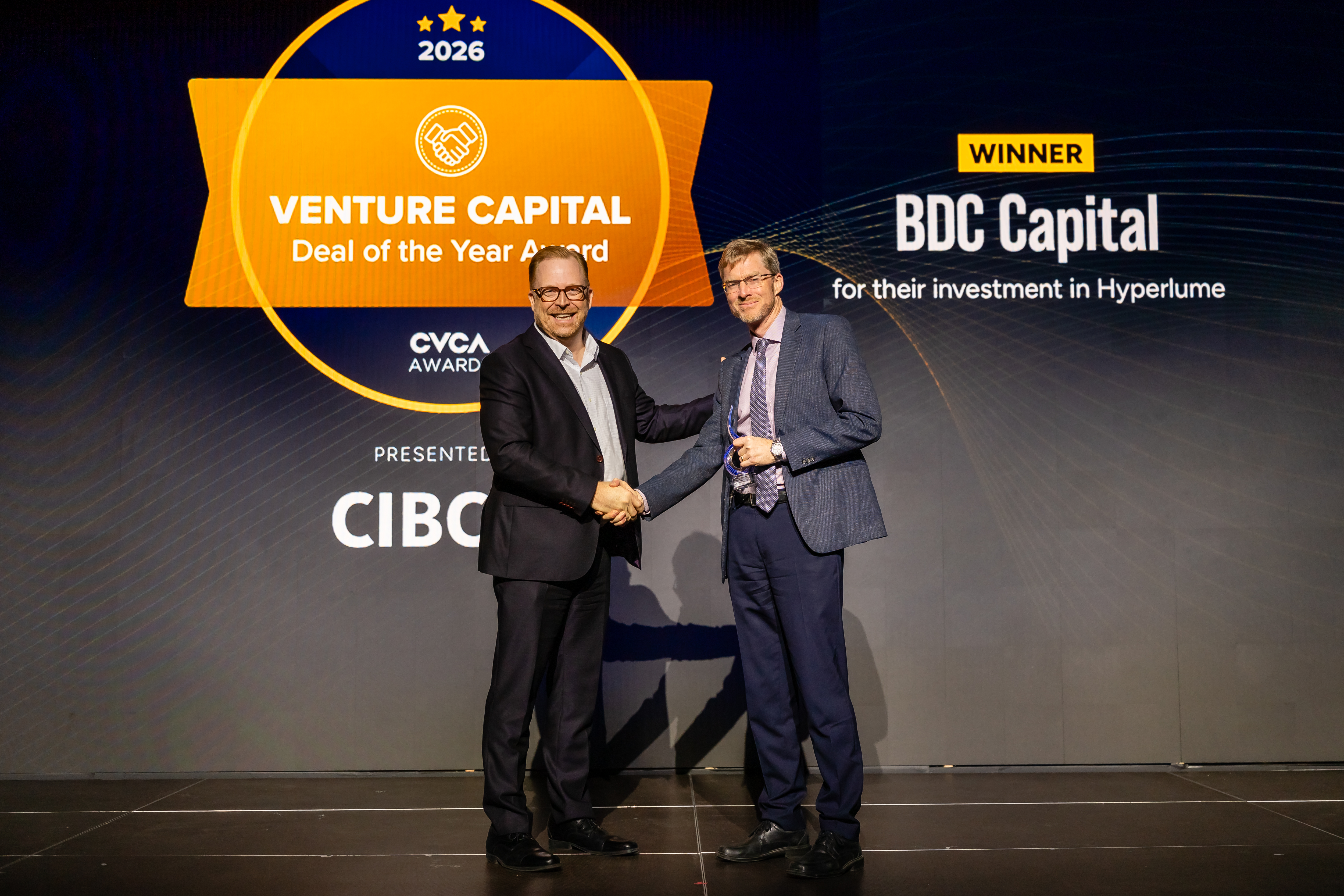
Hyperlume’s rapid progress attracted the attention of Credo Technology Group, a San Jose–based company specializing in high-speed connectivity solutions for AI data centres around the world. As AI adoption accelerated, Credo saw Hyperlume’s technology as a natural complement to its existing product portfolio. That strategic alignment led to Credo’s acquisition of Hyperlume in October 2025, guided by BDC partner Erin Sheets. The transaction earned BDC Capital the VC Deal of the Year Award, sponsored by CIBC Innovation Banking.
“Credo was a tremendous opportunity for us,” says Mohsen. “They have an outstanding culture, a remarkable leadership team and a huge market opportunity in front of them. We had technology that could help expand that opportunity even further. It was a natural fit, and we were fortunate that our investors like BDC supported us throughout the process and helped make the transition seamless.”
“From the beginning, when we first met Mohsen and Hossein, it was clear they had built something special with Hyperlume,” says Bill Brennan, president and CEO of Credo. “The combination of differentiated technology, a talented team and a vision that aligned well with Credo’s direction made the opportunity compelling. Bringing Hyperlume into Credo has been an important step in expanding our capabilities, and we continue to see meaningful opportunities as microLED technology complements our high-speed connectivity portfolio. The acquisition also strengthens our presence in Ottawa, a region recognized for its strong engineering talent and photonics expertise. Overall, Hyperlume has proven to be an excellent fit for Credo across technology, talent and long-term strategy.”
Following the acquisition, Credo committed to expanding its Ottawa operations, with plans to double the size of Hyperlume’s local team and deepen its investment in Canadian innovators. “Mohsen and Hossein exemplify the differentiated deep tech talent we have in Canada,” says Stewart. “That’s especially true in their domain of semiconductor chips for data communications, where Canada has an edge on the world exactly when AI data centres need it most.”